Home / Tools / IOPS & Throughput
IOPS / Throughput Converter
Four quick calculators for the numbers that come up in workload analysis and replication planning.
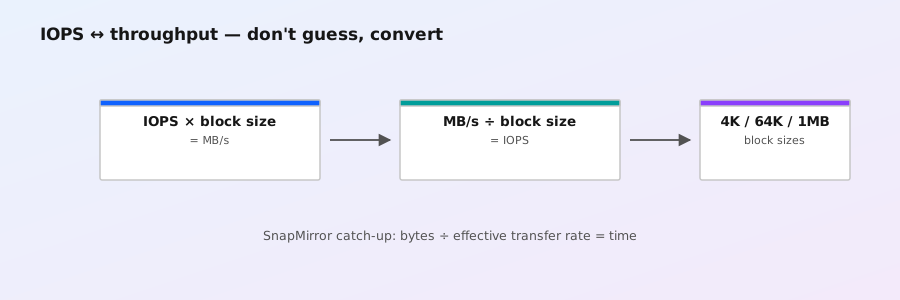
MB/s ↔ IOPS
Formula: IOPS = MB/s × 1024 / block size (KiB). MB/s = IOPS × block size / 1024.
Workload envelope: throughput + outstanding I/O
Translate an observed or target IOPS rate into throughput, then estimate how many I/O requests must be in flight at the stated average latency.
Formulas: throughput = IOPS × KiB ÷ 1024; outstanding I/O ≈ IOPS × latency seconds (Little's Law).
SnapMirror catch-up estimator
How much sustained throughput do you need to move (or catch up) a dataset within a time window?
Formula: MB/s = TiB × 1,048,576 / (hours × 3600) / efficiency. This is a planning estimate — real SnapMirror throughput depends on network, source load, and change rate.
Network link headroom
Check whether a measured or planned payload rate fits on a link after reserving room for protocol overhead and traffic bursts.
Formula: payload bit rate = MiB/s × 1,048,576 × 8 ÷ 1,000,000,000. Usable capacity = nominal Gb/s × usable-link percentage. This is link arithmetic, not an ONTAP or network performance guarantee.