Home / Certifications
NetApp Certifications Hub
Choose a foundation, administration, implementation, or installation track—then pair the current official blueprint with practical ONTAP study guides and hands-on labs.

Choose a track
NCTSP / legacy NCSA
NS0-005. Portfolio and storage foundations. NCSA and NCTA are legacy names; NCTSP is the current foundation credential.
NCDA, ONTAP
NS0-185. Administration, protocols, protection, security, performance, and troubleshooting.
NCIE tracks
SAN ONTAP NS0-521, Data Protection NS0-528, MetroCluster NS0-015, and E-Series.
NCSIE, ONTAP
Physical/logical installation, cabling, cluster build, expansion, validation, troubleshooting, and handoff.
NetApp University & learning paths
Official course catalog, learning paths, documentation, labs, NetApp Console/BlueXP practice, and a blueprint-driven study workflow.
NCDA study library
ONTAP fundamentals
Clusters and HA pairs, SVMs, aggregates, FlexVol and FlexGroup, WAFL, snapshots, thin provisioning basics, management surfaces.
Storage networking
NFS, SMB, S3, FC, FCoE, iSCSI, NVMe/FC and NVMe/TCP, LIFs, routing, export policies and shares.
Data protection
Snapshots, SnapMirror (async, sync, SM-BC), SnapVault, MetroCluster, NDMP, SnapLock, ransomware protection.
Storage efficiency
Thin provisioning, deduplication, compression, compaction, FlexClone, and how to measure savings.
HA, QoS & security
Takeover/giveback, cluster switchover, storage QoS and adaptive QoS, encryption (NVE/NAE), RBAC, monitoring.
Practice questions
Interactive NCDA-style questions with detailed explanations. Click an answer to check yourself.
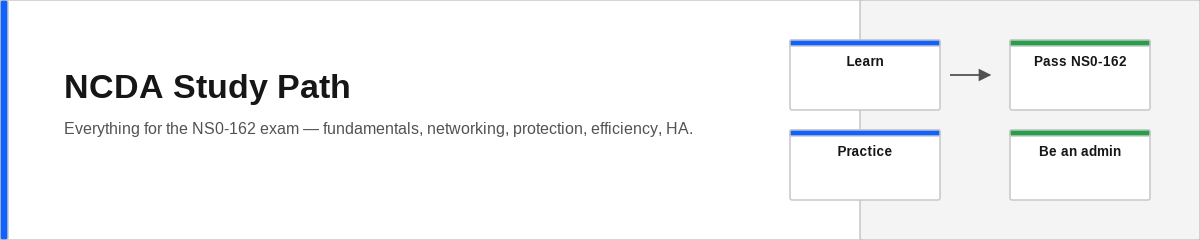
Suggested NCDA study order
- Fundamentals — the object model everything else hangs off
- SVM administration guide — create and configure SVMs, protocols, LIFs, routing, and name services
- Storage networking — how clients reach data
- Data protection — the highest-weighted exam domain
- Storage efficiency — why ONTAP makes capacity go further
- HA, QoS & security — resilience, control, and day-2 ops
- Practice questions — then re-read the weak areas
Turn the exam blueprint into a study loop
Begin with the current NetApp exam page and blueprint, not a remembered exam code or an old question bank. Convert each blueprint objective into a checklist: explain the concept, locate it in System Manager, identify the corresponding ONTAP objects, and find the first-party procedure that governs it. Revisit the official catalog before booking because exam availability, objectives and prerequisites can change.
Use a lab to connect vocabulary to observable state. For every protection, networking or capacity scenario, write down the object boundary first: cluster, node, SVM, volume, LIF or relationship. Then predict the result before checking it. This exposes common mistakes such as confusing an SVM with a node, a Snapshot copy with a remote replica, or administrative state with operational state.
Practice questions are a diagnostic, not an answer source. Record why each wrong choice is wrong, link the correction to current NetApp documentation, and repeat the weak objective in a lab. Avoid memorizing output whose release context is unknown; command fields and workflows can differ between ONTAP trains.
Authoritative starting points: NetApp certification catalog and ONTAP documentation.