Implementation tracks go beyond administration into assessment, design dependencies, deployment, validation, and troubleshooting.
Track
Exam
What it validates
NCIE SAN Specialist, ONTAP
NS0-521
FC fabrics, NVMe, iSCSI, host integration, zoning, provisioning, multipath, testing, and troubleshooting.
NCIE Data Protection
NS0-528
Requirements, backup and DR policy, ONTAP replication, SnapCenter/BlueXP, business continuity, restore, and troubleshooting.
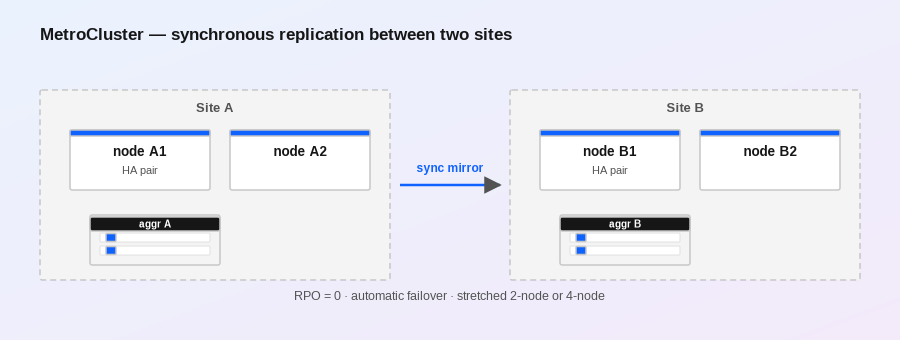
NCIE MetroCluster
NS0-015
Current MetroCluster FC/IP planning, implementation, expansion, transition, validation, and troubleshooting. Older policy pages may show NS0-014.
NCIE SAN Specialist, E-Series
Confirm in CertCenter
SANtricity, DDP/volume groups, hosts and multipathing, cabling, protection, and E-Series troubleshooting.
PrerequisitesNetApp’s ONTAP SAN, Data Protection, and MetroCluster pages require NCDA first. The public catalog and exam codes change; follow the registration link from the official certification page.
Preparation pattern
Download the current blueprint and turn every objective into a lab task.
Use Hardware Universe and IMT for configuration constraints instead of memorizing unsupported combinations.
Practice normal deployment, validation, rollback, and failure diagnosis in a lab.
For Data Protection, exercise ONTAP System Manager/CLI plus SnapCenter and BlueXP workflows.
What SAN implementation readiness looks like
The official SAN ONTAP specialist scope is broader than provisioning a LUN. It spans assessment, ONTAP SAN concepts, implementation and configuration, then testing and troubleshooting. The published objectives explicitly include inventory and prerequisites, environmental and physical constraints, controller and storage-space concepts, SVM configuration, FC, NVMe and iSCSI, switches and hosts, data protection, migration, and supportability tools.
Plan
Build an implementation record with host operating systems, adapters, switch firmware, protocols, path counts, capacity and protection requirements. Validate combinations in IMT and hardware constraints in Hardware Universe instead of assuming that individually supported parts form a supported solution.
Implement
Be able to explain the dependency chain from physical connectivity and zoning through SVM protocol configuration, initiators, LUN or namespace presentation, and host multipathing. Capture the expected state before testing failure paths.
Validate and troubleshoot
Prove discovery, optimized and non-optimized paths, planned failover behavior, recovery, and application access. A useful lab report records the symptom, evidence, change, verification, and rollback rather than only the final working configuration.
Experience and source control
NetApp’s Learning Services FAQ recommends six to twelve months of experience planning, implementing, and validating end-to-end SAN solutions in FC and iSCSI environments before the NCIE exam, with clustered SAN implementation experience strongly recommended. Treat that as a readiness signal, not a substitute for the current track page. Blueprint revisions and exam codes can change, so download the current objectives when you begin and check them again before scheduling.
Build a defensible lab portfolioFor each blueprint domain, retain a diagram, compatibility evidence, implementation checklist, validation output, one induced failure, and a recovery note. This turns broad objectives such as “testing” or “troubleshooting” into observable work and exposes gaps that passive reading hides.