Home / Certifications / Storage Networking
Storage Networking
How clients reach data on ONTAP: file protocols (NFS, SMB, S3), block protocols (FC, FCoE, iSCSI, NVMe/FC, NVMe/TCP), and the LIF/network layer underneath.
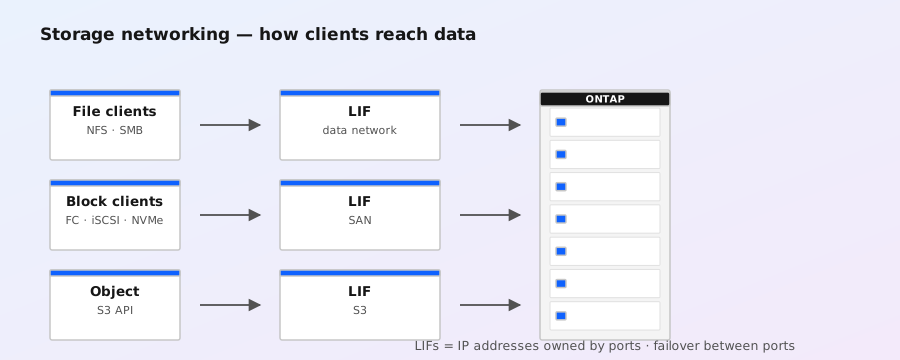
Protocol overview
| Protocol | Type | Port(s) | Notes |
|---|---|---|---|
| NFSv3 / NFSv4.x | File (NAS) | 2049 (TCP/UDP), portmapper 111 | Unix/Linux, VMware (NFS), Kubernetes |
| SMB 2.1 / 3.0 / 3.1.1 | File (NAS) | 445 (TCP) | Windows, macOS; AD/Kerberos |
| S3 | Object | 80 / 443 | Built-in object store on FlexVols (ONTAP 9.4+) |
| FC | Block (SAN) | — | Zoning + LUN masking (igroups) |
| FCoE | Block (SAN) | — | FC over Ethernet; less common now |
| iSCSI | Block (SAN) | 3260 (TCP) | IP SAN; CHAP auth; MC/S for multipath |
| NVMe/FC | Block (SAN) | — | NVMe over Fibre Channel (ONTAP 9.4+) |
| NVMe/TCP | Block (SAN) | 4420 (TCP) | NVMe over Ethernet (ONTAP 9.10+) |
Which to pick
NAS (NFS/SMB) for file workloads and VMware; S3 for object/analytics workloads; FC/iSCSI for databases and Windows Server Failover Clustering; NVMe/FC or NVMe/TCP for very low-latency, high-I/O block workloads (SQL Server, Oracle, SAP HANA).
NAS: NFS
- ONTAP serves NFSv3, NFSv4.0, and NFSv4.1; NFSv4.2 features (space-efficient reflinks) arrived in ONTAP 9.8+. NFSv3 is still the workhorse for Linux/VMware; NFSv4.1 adds sessions (stateful, better recovery) and is common in VMware vSphere.
- Export policies control who can mount what: each rule matches a client (by IP, netgroup, or DNS) and allows/disallows with a security flavor (
sys,krb5,krb5i,krb5p,ntlm). Thedefaultexport policy has adefaultrule that grants nothing until you edit it — a common first-mount surprise. - Root squash maps client root (uid 0) to the anonymous user (65534) — enabled by default; needed for security on NFS.
- NFSv4 ID domain — Unix uid/gid ↔ Windows SID mapping must resolve via the SVM's NFSv4 domain config (
defaultv4iddomain.comunless set to match your AD/Kerberos realm). A mismatch shows up as squashed/mismatched ownership. - Exports are paths in the SVM namespace (e.g.,
/vol1or a junction like/data).
# NFS service + export policy
vserver nfs show -vserver vs1
vserver export-policy show
vserver export-policy rule show -vserver vs1 -policy default
# Add: allow 10.1.2.0/24 to mount /vol1 with sys auth
vserver export-policy rule create -vserver vs1 -policy default -v4client 10.1.2.0/24 -protocol nfs -rorule sys -rwrule sys
# Test what a client would see (very useful for troubleshooting)
vserver export-policy check-access -vserver vs1 -client-ip 10.1.2.50 -volume vol1 -authentication-method sys
NAS: SMB/CIFS
- SMB 1.0 is disabled by default in ONTAP 9.x — good for security; legacy clients need explicit re-enabling (not recommended).
- A CIFS server is created per SVM, joined to Active Directory. Shares map to namespace paths; NTFS/SMB ACLs plus export-policy-like share ACLs both apply.
- Kerberos for authentication, SMB 3.x for encryption (SMB over QUIC appears in recent ONTAP releases for secure access over untrusted networks — verify version support before relying on it).
- Use
vserver cifs sharecommands to manage shares and their access control (everyone vs. specific groups).
# SMB service + shares
vserver cifs show -vserver vs1
vserver cifs share show -vserver vs1
vserver cifs share create -vserver vs1 -share-name data -path /data -share-properties oplocks
Object: S3
- ONTAP 9.4+ includes a native S3 object-store server on FlexVols — buckets and objects, S3 API compatible (for the supported API surface).
- Use cases: backup targets (e.g., for other NetApp systems via SnapMirror S3), analytics, simple object storage in hybrid clouds.
- Configured per SVM; bucket access via access keys / IAM-style policies (limited).
# S3 object store server + bucket
vserver object-store-server create -vserver vs1 -object-store-server-name s3svm -root-user root -root-password MyP@ssw0rd
vserver object-store-server show
vserver object-store-server bucket create -vserver vs1 -bucket backups
SAN: FC, iSCSI, NVMe
- FC — the classic SAN path. The SVM exposes a WWNN/WWPN per LIF; the fabric is zoned (initiator WWPN ↔ target WWPN), and igroups (initiator groups) map hosts to LUNs with LUN IDs. LUN masking = igroup membership.
- FCoE — FC encapsulated over Ethernet (10/25GbE converged fabric). Less common in new designs.
- iSCSI — LUNs over TCP/IP. Each data LIF is an iSCSI target portal; hosts use IQNs; CHAP authenticates. Multipath via MC/S (multiple connections per session) or multiple LIFs.
- NVMe/FC (ONTAP 9.4+) and NVMe/TCP (ONTAP 9.10+) — NVMe namespaces instead of LUNs; lower latency, deeper queues. NVMe/FC needs FC-NVMe-capable switches. Verify platform support for NVMe/TCP in the ONTAP release you run.
- Block protocol note: a LUN is a file inside a volume (usually a dedicated volume). The volume must exist before the LUN; space can be thin.
# SAN objects
vserver fcp show -vserver vs1
vserver iscsi show -vserver vs1
iscsi initiator show
vserver iscsi connection show -vserver vs1
# LUN + igroup
lun create -vserver vs1 -volume lunvol -lun /vol/lunvol/lun0 -size 2t -ostype linux
igroup create -vserver vs1 -igroup host1 -protocol iscsi -initiator iqn.1994-05.com.example:host1
lun map -vserver vs1 -path /vol/lunvol/lun0 -igroup host1 -lun-id 0
LIFs and the network layer
- LIF (logical interface) = an IP address (or FC WWPN) on a node/port, with a role:
data,mgmt,node-mgmt,cluster,intercluster. Data LIFs belong to SVMs; cluster LIFs form the interconnect. - LIFs have a home node/port and fail over to a partner per failover policy — this is what makes LIF migration and nondisruptive node maintenance work.
- Underneath: ifgrps (port channels:
mode multimode_lacpetc.) aggregate physical ports; VLANs tag traffic; routing per SVM vianetwork route.
# Network state
network interface show
network interface show -fields home-node,home-port,status-oper
network port show -fields link,duplex,speed
network route show -vserver vs1
# Create a data LIF
network interface create -vserver vs1 -lif data1 -role data -data-protocol nfs -home-node node1 -home-port e0c -address 10.0.0.5 -netmask 255.255.255.0
# Test connectivity to a LIF from the cluster
network ping-lif -vserver vs1 -lif data1
Exam traps to know
- Export policies control NFS mounts; igroups control SAN LUN access; share ACLs + NTFS ACLs control SMB access. Don't mix them up.
- NFSv3 is stateless; NFSv4.x is stateful (sessions/locks).
- LUNs live in volumes — you can't create a LUN without a volume.
- Data LIFs belong to SVMs; a LIF's failover is about network availability, not storage takeover.
- SMB needs the SVM joined to AD (or workgroup for simple setups); Kerberos issues usually show up as auth failures, not share-not-found.
- iSCSI + FC use igroups (initiator WWPN/IQN → LUN mapping). NVMe uses subsystems/namespaces — same concept, different vocabulary.