Home / Certifications / HA, QoS & Security
HA, QoS & Security
Keeping ONTAP available (takeover/giveback), predictable (QoS), and locked down (encryption, RBAC) — plus how to watch all of it.
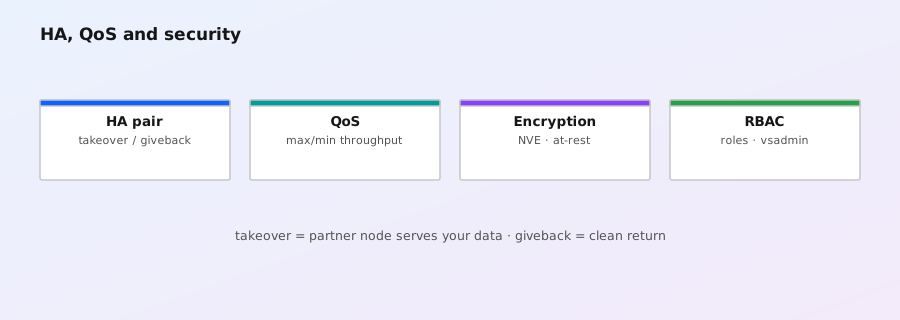
High availability: takeover & giveback
- Nodes are deployed in HA pairs; each node's NVRAM is mirrored to the partner over the HA interconnect. If a node fails (or is taken down for maintenance), the partner takes over: it serves the failed node's aggregates, LIFs, and data — no data loss, because writes were in mirrored NVRAM.
- Takeover can be planned (
storage failover takeover -ofnode X, used for hardware maintenance) or unplanned (panic/power loss). - Giveback (
storage failover giveback -ofnode X) returns storage to the home node once it's healthy. - While in takeover, performance is roughly halved (one node serving two) — plan maintenance windows accordingly.
- Related: nondisruptive operations (NDO) — LIF migration, volume move (
volume move start), and rolling upgrades let you do most work without client impact.
# HA status and control
storage failover show
storage failover takeover -ofnode node2
storage failover giveback -ofnode node2
# Volume migration (NDO)
volume move start -vserver vs1 -volume vol1 -destination-aggregate aggr2
MetroCluster vs HA
HA pairs protect against node failure (same site). MetroCluster protects against site failure (switchover/switchback). Same concepts (mirrored NVRAM, takeover), different scope.
Storage QoS
- QoS policy groups cap throughput (IOPS and/or MB/s) on volumes, LIFs, or SVMs — protect the noisy neighbor, guarantee a baseline for critical apps.
- Adaptive QoS (AQoS) (ONTAP 9.3+) — throughput limits that scale with volume size: you define expected and peak IOPS per TB (e.g., 500 IOPS/TB expected, 1000 peak). As the volume grows, its limit grows. Much easier to manage at scale than fixed limits.
- QoS is also the measurement surface:
qos statistics volume showgives per-volume latency/throughput — the fastest way to find a hot volume.
# Fixed QoS
qos policy-group create -policy-group pg_critical -vserver vs1 -max-throughput 10000IOPS,500MBps
volume modify -vserver vs1 -volume vol_crit -qos-policy-group pg_critical
# Adaptive QoS
qos adaptive-policy-group create -name apg_gold -vserver vs1 -expected-iops-per-tb 500 -peak-iops-per-tb 1000
volume modify -vserver vs1 -volume vol_gold -qos-adaptive-policy-group apg_gold
# Measure
qos statistics volume show -vserver vs1 -volume vol_crit -interval 5
Security
Encryption
- NVE (NetApp Volume Encryption) — software AES-256 encryption per volume, on any supported disk. Keys come from an external KMIP server or the built-in Onboard Key Manager (OKM). NVE for AFF since ONTAP 9.1, FAS a bit later. (Verify exact versions.)
- NAE (NetApp Aggregate Encryption, ONTAP 9.4+) — encrypts whole aggregates with per-volume keys; less overhead than per-volume NVE, recommended default for new encrypted systems.
- SEDs (self-encrypting drives / FIPS drives) — hardware encryption at the disk; combined with NAE/NVE for defense in depth.
- Key management is the operational crux: lost keys = unrecoverable data. Back up keys; OKM requires quorum (multiple nodes).
# Encryption status
security key-manager onboard show
volume show -fields encryption,encrypt
storage aggregate show -fields encryption-type
Access control & hardening
- RBAC: built-in roles (
admin,vsadmin,vsadmin-protocol, …) and custom roles per command/object. Users login via SSH/HTTP; auth via local passwords, AD/LDAP, or certificates. - FPolicy — per-SVM file access policies: monitor/block operations (used for ransomware detection, DLP, and home-directory quotas integration).
- Firewall/service policies — control which management services are reachable on which LIFs.
- SnapLock for WORM retention (see data protection).
- Keep AutoSupport enabled — it feeds Active IQ and is the fastest path to support/insight.
- Operational version of all of the above: the security hardening checklist (RBAC + multi-admin verification, NAE/NVE, ARP, SnapLock, TLS lockdown, audit forwarding).
# RBAC examples
security login create -vserver vs1 -user-or-group-name ops -application ssh -authmethod password
security login show
security role show -vserver vs1
Monitoring & events
- EMS (Event Management System) — the event log is your first stop:
event log show, filter by severity/time/message name. - System health —
system health alert showfor hardware issues (disks, shelves, fans, batteries). - Performance —
statisticsandqos statistics volume show(see the performance guide). - Jobs —
job showfor long-running operations (moves, efficiency scans, upgrades). - AutoSupport —
autosupport show/autosupport invoke -type test.
# Events & health
event log show -severity ERROR -time ">now-24h"
system health alert show
job show -type volume-move
autosupport show
Exam traps to know
- Takeover is about storage failover between HA partners; it doesn't move data — the partner serves the same aggregates.
- Adaptive QoS scales with volume size; fixed QoS doesn't. Question will tell you which scenario needs which.
- NVE encrypts per volume; NAE encrypts per aggregate. Keys via KMIP or Onboard Key Manager.
- RBAC is per vserver (data SVM) or cluster;
vsadmincan't manage other SVMs' objects. event log showfor software/EMS events;system health alert showfor hardware.- QoS limits are ceilings (max), not guarantees, unless you configure expected/peak correctly with AQoS.