Analysis of the triggering Unisba Media listing, checked against Broadcom's Q3 FY2026 results filed with the SEC and our own NTAP market series.
AVGO NTAP FINANCE AI INFRASTRUCTURE 2026-10-17
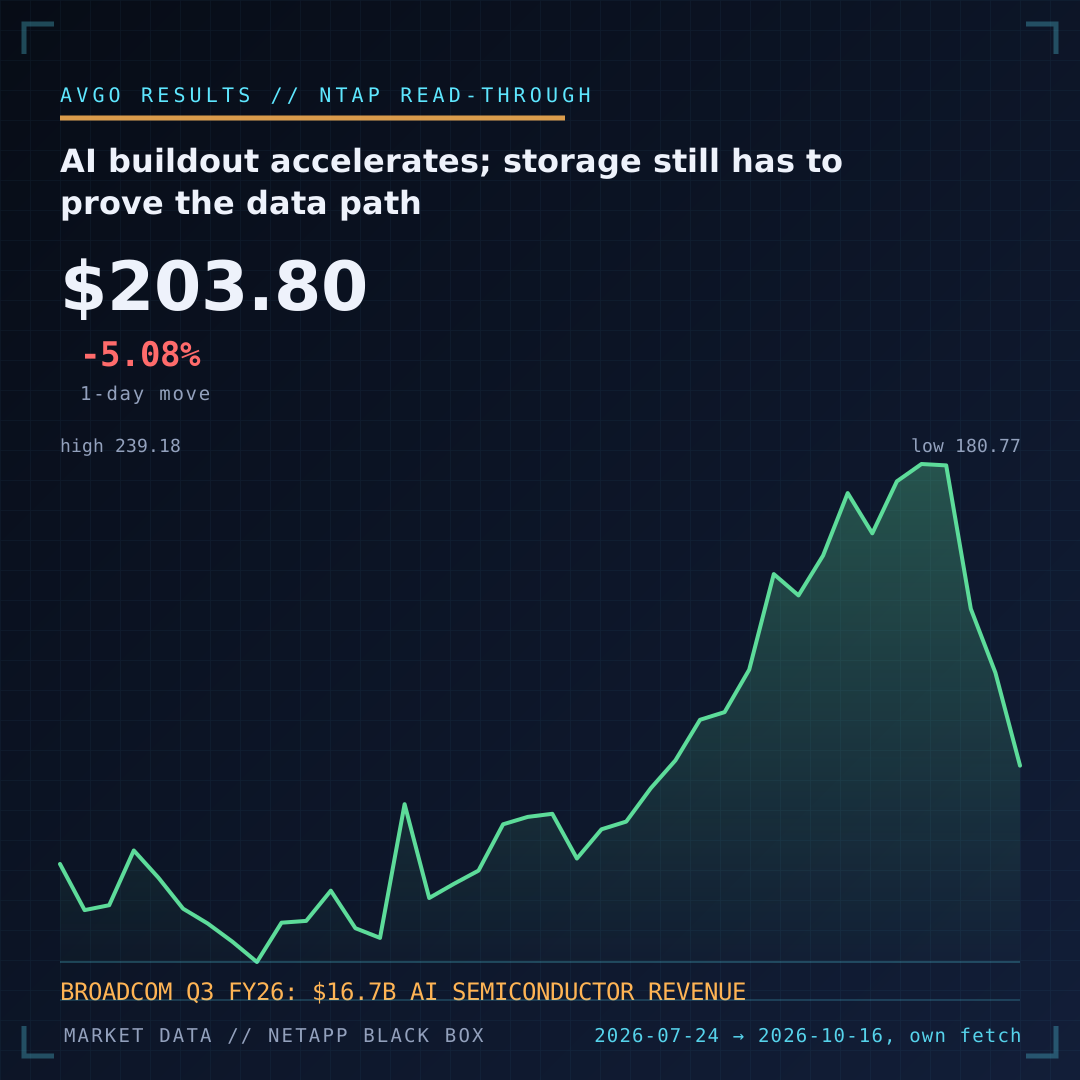
The result in one screen
Broadcom reported fiscal Q3 2026 revenue of $29.591 billion, up 86% year over year. GAAP operating income was $15.955 billion; non-GAAP operating income was $20.095 billion. GAAP diluted EPS was $2.68 and non-GAAP diluted EPS was $3.32. Cash from operations reached $14.197 billion and free cash flow was $13.665 billion, or 46% of revenue.
The margin picture was equally large but needs the right label. Broadcom's GAAP gross profit was $20.456 billion, which is a 69.1% GAAP gross margin by our calculation. Its reconciliation shows $22.191 billion of non-GAAP gross profit, a 75.0% non-GAAP gross margin. Those are consolidated measures across chips and software, not storage-system margins.
The mix: AI chips drove the acceleration
Semiconductor solutions supplied $20.839 billion, 70% of company revenue and up 127% year over year. Infrastructure software supplied $8.752 billion, 30% of revenue and up 29%. Inside the chip business, management disclosed $16.7 billion of AI semiconductor revenue, up 221% year over year and 54% sequentially.
That makes AI semiconductor revenue roughly 56% of total company revenue and about 80% of semiconductor revenue, calculations from Broadcom's disclosed figures. The filing identifies custom AI accelerators and networking as the demand sources. It does not break out storage, VMware, Snowflake, HPE or NetApp revenue within that AI number.
Guidance says the buildout is still accelerating
For fiscal Q4, Broadcom guided to approximately $34.8 billion of revenue, up 93% year over year, and non-GAAP operating income of about 66% of projected revenue. Management expects AI semiconductor revenue of $21.7 billion, up 236% year over year.
At those guideposts, AI semiconductors would be about 62% of Q4 revenue, while the AI line would grow about 30% sequentially from Q3. The signal is unusually direct: demand for accelerator and fabric silicon is not merely holding; Broadcom expected another large step-up when it issued the guidance.
What drove the move—and what we cannot claim
The earnings facts support a positive AI-infrastructure demand reading, but the supplied media wrapper does not provide a verifiable October 16 AVGO or NTAP reaction, analyst note or company event. We therefore do not assign Broadcom's month-old result as the cause of NTAP's 5.08% October 16 decline to $203.80.
Our series shows NTAP down 14.1% over five sessions but still up 26.5% over three months. That is the tape, not an operating result. The distinction matters: a correlated selloff across infrastructure names may reflect changing expectations, but price co-movement alone cannot identify which revenue, margin or demand assumption changed.
The storage read-through: more compute creates a data-path test
Broadcom's accelerator and networking growth is upstream evidence that AI clusters continue to be built. It is not a one-for-one forecast for enterprise storage. Accelerators can be deployed before data pipelines, capacity and governance budgets reach a storage vendor, and hyperscalers can satisfy some demand with internal designs.
For storage customers, the practical consequence is a harder design problem: the data layer must keep accelerators fed, stage training data, absorb checkpoints, preserve metadata performance and protect results without turning expensive GPU time into I/O wait. The relevant buying evidence is measured workload behavior—not a semiconductor revenue multiple.
Use the site's capacity-planning guide to separate usable capacity, growth headroom and protection overhead. Then validate throughput, concurrency, small-file behavior, checkpoint windows and recovery objectives against the actual pipeline. The AI topic hub and financials hub keep product evidence separate from market claims.
What to watch next
- AI mix: whether Q4 AI semiconductor revenue reaches the stated $21.7 billion.
- Margin: whether Broadcom holds the guided 66% non-GAAP operating-income ratio as the mix shifts further toward AI silicon.
- Storage proof: disclosed customer deployments, benchmarked data-path performance and storage-vendor bookings—not generic use of “AI” in commentary.
- NTAP fundamentals: NetApp's own revenue, all-flash performance, margin, cash conversion and guidance rather than an inferred AVGO linkage.
Bottom line
Broadcom's filed quarter shows an AI buildout accelerating at extraordinary scale: $16.7 billion of Q3 AI semiconductor revenue and a $21.7 billion Q4 expectation. That is a real demand signal for accelerator and network infrastructure. For storage, it defines the opportunity but does not prove vendor-specific revenue. The useful customer response is to test the data path; the useful investor response is to keep Broadcom's results and NTAP's price action as separate evidence until a direct link is disclosed.
Sources: Broadcom Q3 FY2026 SEC-filed earnings release · Broadcom Q3 Form 10-Q · Unisba Media listing via Google News. Market prices: state/ntap_market.json, sourced from the Yahoo Finance chart API and rendered locally. Calculations are NetApp Black Box analysis. Not investment advice.