NTAP EARNINGS AI INFRASTRUCTURE 2026-10-27
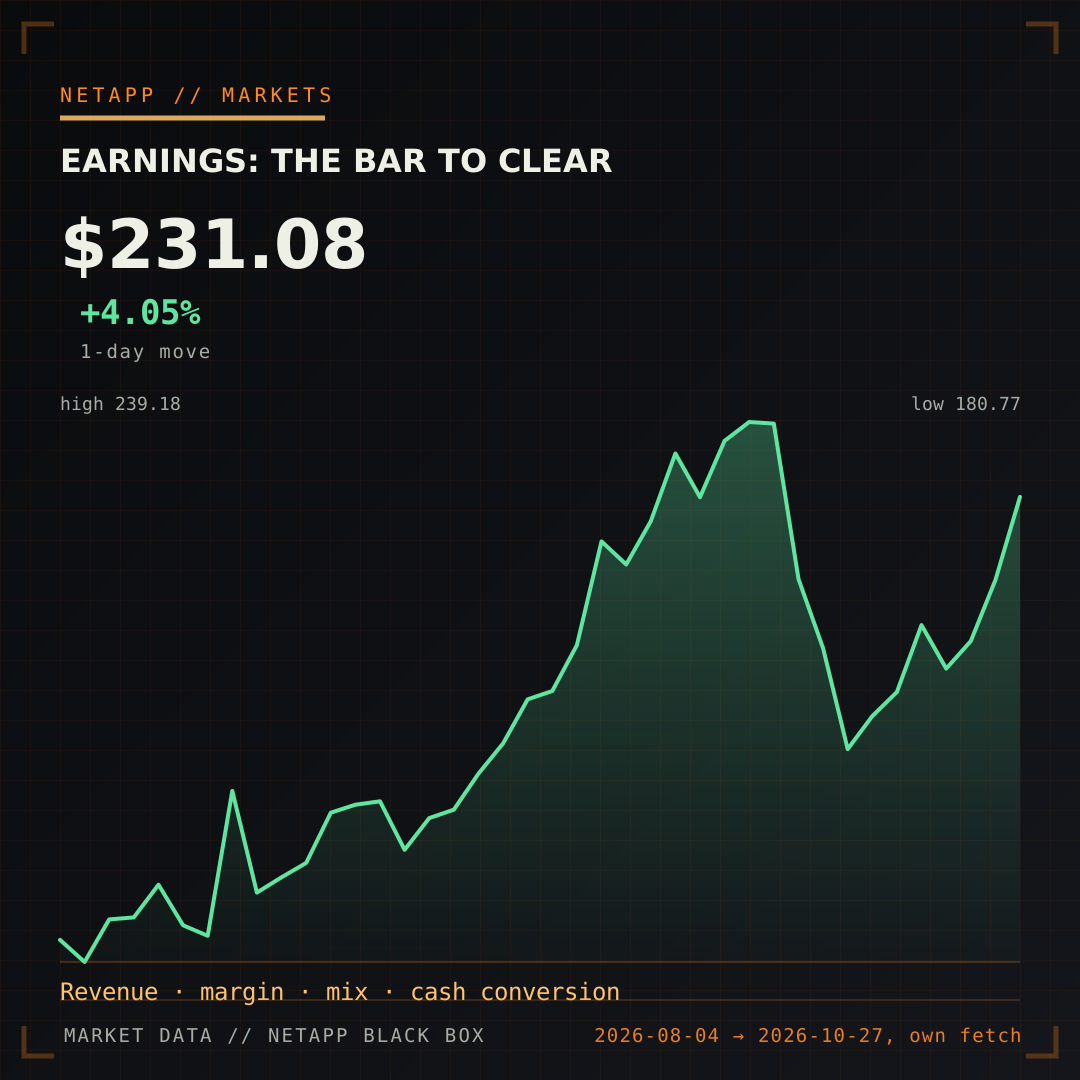
state/ntap_market.json; no publisher chart is reproduced.The preview starts with a source-date correction
Barchart’s article expected adjusted earnings of $1.45 per share for the quarter NetApp was due to report on November 26, 2024, up 17.9% from the year-earlier period. That was a valid historical estimate, but it is not the bar for NetApp’s next 2026 report. Readers arriving from the resurfaced headline should not carry the $1.45 estimate forward.
The useful current question is narrower: what must the next report show against NetApp’s latest company-issued guidance? The answer lives in revenue, margins, segment mix and cash conversion—not in the age of a syndicated headline.
The current scorecard and guidance bar
NetApp’s latest reported quarter, Q1 FY27, produced $2.025 billion in revenue, up 30% year over year. GAAP gross profit was $1.419 billion, which implies a 70.1% GAAP gross margin; GAAP operating margin was 23.9%, versus 31.9% non-GAAP.
For Q2 FY27, management guided revenue to $2.025–$2.175 billion, GAAP gross margin to 66.0–67.0%, GAAP operating margin to 24.9–25.9%, and non-GAAP EPS to $2.54–$2.64. Full-year revenue guidance was $7.975–$8.225 billion. Those ranges are the company’s disclosed bar; analyst consensus can move independently.
Mix matters more than the headline total
Hybrid Cloud revenue was $1.819 billion, up 30%, while Public Cloud revenue was a record $206 million, up 28%. Inside Hybrid Cloud, all-flash revenue reached a record $1.309 billion, up 47%; hybrid-flash and other revenue was $510 million, up only slightly from $505 million.
That makes all-flash the clearest disclosed high-performance-storage demand signal. It does not make all-flash an AI segment: NetApp reports Hybrid Cloud and Public Cloud, not AI and non-AI revenue. For architecture context, the AI topic hub separates product evidence from market narrative, while the financials hub keeps the reporting baseline visible.
What would validate the AI-infrastructure thesis
The quarter included record all-flash and Public Cloud revenue, and NetApp tied its DataPelago acquisition to accelerating AI deployments. Those disclosures support an AI-infrastructure opportunity. They do not quantify AI revenue, AI backlog or an AI-specific gross margin.
The next report becomes more informative if management supplies a measurable AI workload contribution, customer count, backlog or attach rate. Without that, the defensible test is whether all-flash growth remains faster than total revenue while margins stay inside guidance. Product announcements alone do not answer the demand question.
The quality check: cash, inventory and margin
Q1 operating cash flow fell 25% to $503 million, and free cash flow fell 35% to $401 million, even as revenue and earnings grew. Net inventory rose to $375 million from $198 million at fiscal year-end, while inventory turns fell to 6 from 14 year over year. The 10-Q says the inventory increase primarily reflected strategic component purchases to mitigate supply-chain constraints.
That does not prove demand weakness, but it makes cash conversion and inventory commentary essential companions to the revenue headline. A revenue beat paired with weak conversion or margin pressure would carry a different operating signal from a clean beat across all three.
Read-through for storage customers
Customers should translate financial momentum into procurement and engineering questions. Faster all-flash demand can affect lead times, discounts and component availability; margin guidance can reveal whether input costs and pricing are being absorbed or passed through. None of it changes an ONTAP support matrix or validates a workload design.
Use the capacity-planning guide to model usable capacity and headroom, then validate workload-specific throughput, latency, recovery objectives and protection overhead. The earnings call can indicate product investment and supply conditions; it cannot replace sizing evidence.
Bottom line
The Barchart preview is a 2024 article resurfacing in a 2026 feed. For the next report, the current tests are NetApp’s $2.025–$2.175 billion revenue range, margin delivery, the durability of 47% all-flash growth, and whether strong earnings convert into cash. AI demand is plausible and strategically visible, but its financial contribution remains not separately disclosed.
Sources: Barchart’s October 30, 2024 preview · NetApp Q1 FY27 results and guidance · NetApp Q1 FY27 Form 10-Q. Margin calculation is NetApp Black Box analysis from the cited GAAP figures. Market data comes from the independent fetch recorded in state/ntap_market.json. Not investment advice.