FINANCE AI STORAGE NTAP 2026-11-02
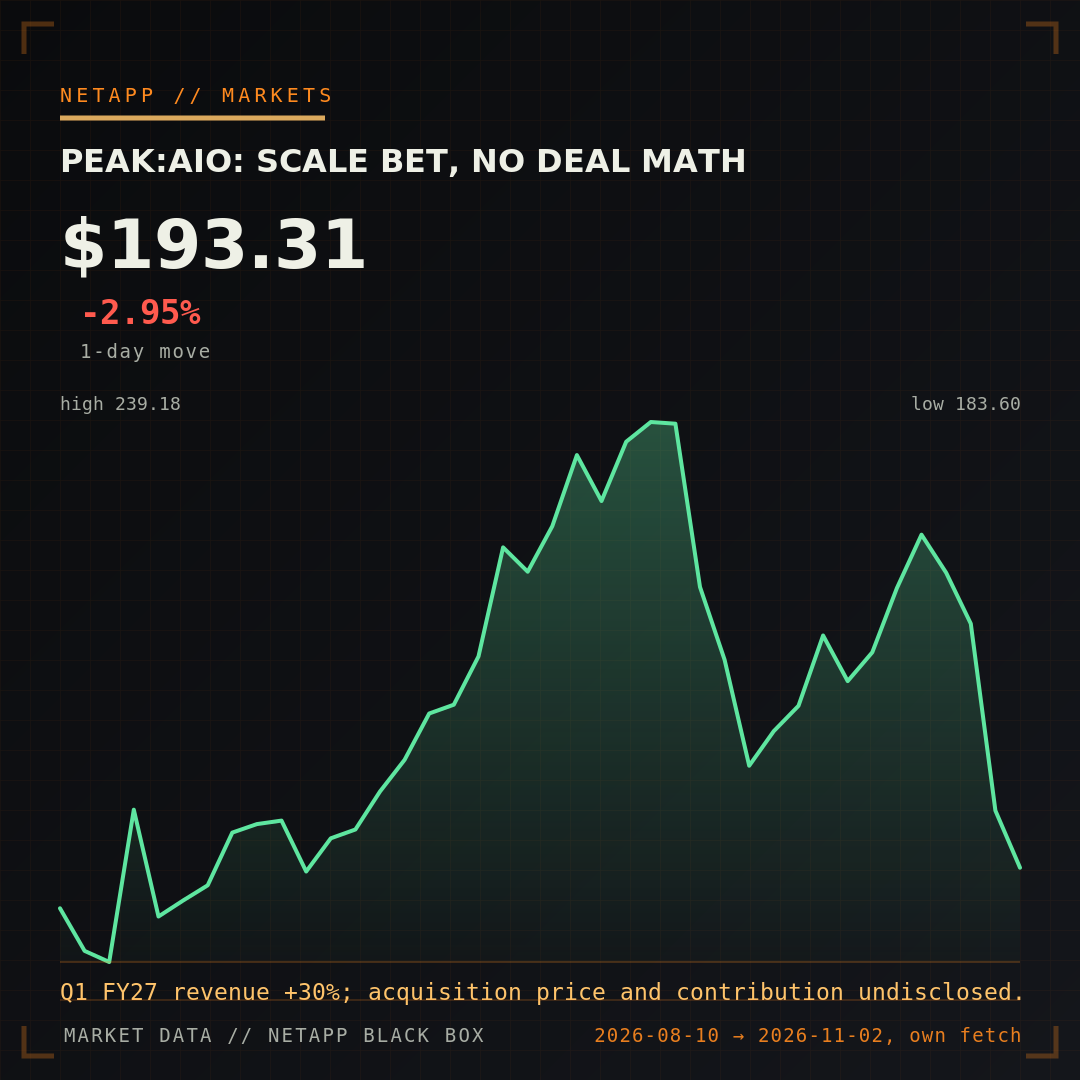
state/ntap_market.json; no publisher chart is reproduced. Price movement does not establish acquisition causality.What NetApp bought
NetApp said it completed the acquisition of Manchester-based PEAK:AIO, a software-defined AI-storage company focused on metadata architecture and high-performance parallel file systems. The announced integration puts PEAK:AIO metadata services and parallel namespace technology into NetApp's ONTAP-based architecture and positions that work behind NetApp Novus.
The intended architecture separates metadata from the data path, uses standards-based parallel NFS access and targets high concurrency under one namespace. NetApp now describes a target of trillions of files and zettabyte-scale deployments. Those are forward-looking design goals: the announcement gives no benchmark configuration, generally available release, price or delivery date on which a customer can base a purchase.
The numbers around the deal
The latest reported quarter remains Q1 FY27: revenue was $2.025 billion, up 30% year over year. Hybrid Cloud contributed $1.819 billion, or 89.8% of revenue, while Public Cloud contributed $206 million. All-flash array revenue reached a record $1.309 billion, up 47%.
GAAP gross profit of $1.419 billion implies a 70.1% gross margin; GAAP operating margin was 23.9%, compared with 31.9% non-GAAP. Operating cash flow fell 25% to $503 million and free cash flow fell 35% to $401 million. The acquisition announcement did not change any of those figures, and PEAK:AIO is not a reportable segment.
Guidance sets the financial hurdle
NetApp's standing Q2 FY27 guidance calls for $2.025–$2.175 billion of revenue, 66.0–67.0% GAAP gross margin and 24.9–25.9% GAAP operating margin. Full-year guidance is $7.975–$8.225 billion of revenue, 67.1–68.1% GAAP gross margin and $9.73–$10.03 of non-GAAP EPS.
The company did not revise guidance when it closed PEAK:AIO. That makes the near-term read-through limited: the deal adds technology and staff, but the release provides no purchase accounting, integration cost, revenue forecast or accretion/dilution estimate. Investors need a later filing or earnings call before assigning a measurable contribution.
What it says about AI-infrastructure demand
The technical bet is specific: expensive GPU clusters lose utilization when storage cannot feed many concurrent reads or absorb large checkpoint writes. NetApp is buying metadata and parallel-file expertise to address that bottleneck while keeping ONTAP as the data-management foundation. The separate July DataPelago purchase addressed processing data near storage; PEAK:AIO addresses namespace and parallel access.
The demand signal is strategic, not a disclosed AI revenue number. NetApp does not report AI revenue or AI-storage bookings separately, and its all-flash total includes databases, virtualization and other enterprise workloads. The 47% all-flash growth supports demand for performance infrastructure, but it cannot be labeled an AI mix.
Read-through for storage customers
Existing ONTAP customers should treat the promised “evolution path” as direction, not entitlement. Before planning a migration, ask for supported ONTAP and hardware combinations, protocol semantics, namespace limits, failure-domain behavior, upgrade and rollback procedures, data-movement requirements and support ownership across NetApp and acquired components.
Parallel NFS does not by itself guarantee application performance. Validate with the real file-size distribution, client concurrency, checkpoint pattern and degraded-mode behavior. Use the ONTAP NFS deep dive to frame protocol and export-policy checks, and the AI operations hub for the broader data-pipeline context. Do not substitute announced scale targets for an acceptance test.
Bottom line
PEAK:AIO gives NetApp specialist metadata and parallel-file technology for the point where storage throughput and namespace concurrency can idle costly GPUs. The financial case is not yet quantified: no deal value, acquired revenue, margin effect or guidance change was disclosed. For customers, this is a roadmap signal worth tracking—not a generally available configuration to buy on announcement day.
Sources: Stock Titan item via Google News · NetApp completion announcement · NetApp acquisition-intent announcement · NetApp Q1 FY27 results. Margin and revenue-mix calculations are NetApp Black Box analysis. Not investment advice.