FINANCE NTAP MARKET MOVE 2026-11-03
state/ntap_market.json; no publisher chart is reproduced.The numbers: another loss, not a verdict on demand
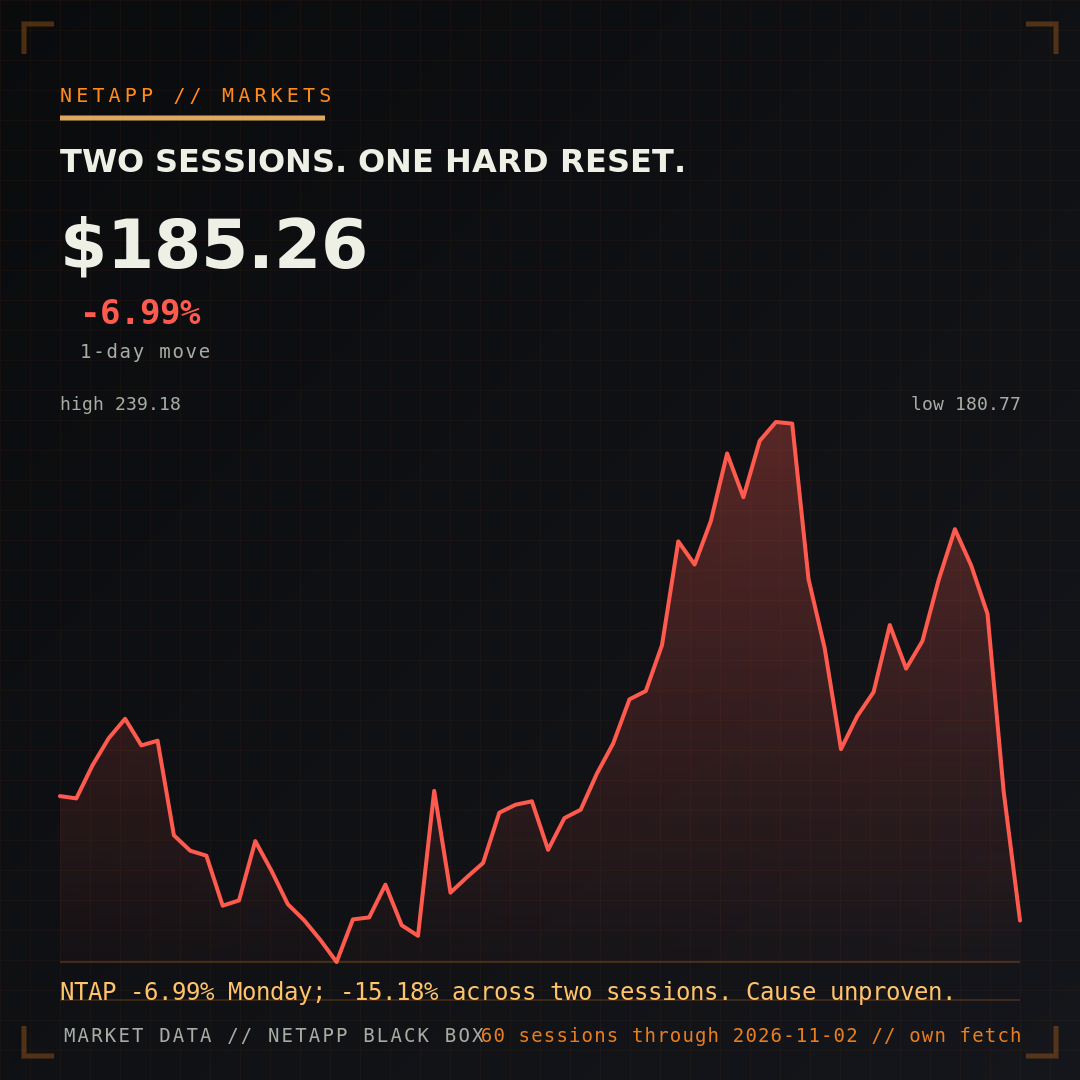
NTAP closed Monday, November 2 at $185.26, down $13.92, or 6.99%, from $199.18. The session range was $184.03–$201.83 on roughly 2.45 million shares. “Underperformed” is literal here: the selected comparison stocks lost less. It is still only a one-session ranking, not evidence that a competitor gained storage share.
The move followed an 8.81% decline on October 30. Across those two sessions, the close fell from $218.42 to $185.26: $33.16, or 15.18%. The local series shows a 16.58% five-session loss and an 18.12% one-month loss, while the year-to-date return remained positive at 66.99%. That combination describes a sharp reset after a strong run; it does not explain the reset.
What drove it: the source does not prove a cause
The recap supplies price, peer and volume observations but no earnings release, guidance revision, customer loss or product defect. NetApp announced completion of its PEAK:AIO acquisition the same day, but timing alone cannot establish that the acquisition caused the decline. The transaction’s price was not disclosed, and planned product capabilities are not the same as booked revenue.
Broader technology selling, valuation compression and concern about execution are plausible hypotheses, not findings from this source. The defensible answer to “why 7%?” is therefore unknown from the available evidence.
The reported business is growing, with a cash-flow caveat
NetApp’s latest filed quarter, Q1 FY27, reported $2.025 billion of revenue, up 30% year over year. Hybrid Cloud revenue was $1.819 billion, up 30%, while Public Cloud revenue reached $206 million, up 28%. Product revenue was $987 million, support revenue $720 million, and professional and other services revenue $112 million.
GAAP gross profit of $1.419 billion implies a 70.1% consolidated gross margin. GAAP operating margin was 23.9%, and non-GAAP operating margin was 31.9%. Operating cash flow fell 25% to $503 million and free cash flow fell 35% to $401 million, so cash conversion is the important counterweight to the revenue and margin growth.
Guidance is the forward scorecard
Management guided Q2 FY27 revenue to $2.025–$2.175 billion, GAAP gross margin to 66.0–67.0% and GAAP operating margin to 24.9–25.9%. Full-year guidance called for $7.975–$8.225 billion of revenue, a 67.1–68.1% GAAP gross margin and $9.73–$10.03 of non-GAAP EPS.
The daily market story reports no change to those ranges. The next fundamental test is whether revenue, mix, margins and cash conversion track that guide. For context beyond a single close, the site’s NetApp financial snapshot keeps the market observation separate from operating results.
AI demand: all-flash is a proxy, not an AI segment
All-flash array revenue reached a record $1.309 billion, up 47% year over year. That supports demand for high-performance data infrastructure, but NetApp does not report AI as a segment. All-flash systems also serve databases, virtualization, consolidation and other enterprise workloads, so the figure cannot be relabelled as AI revenue.
The stock decline likewise does not show that AI-infrastructure demand weakened. A stronger conclusion would require AI-specific bookings, capacity, customer counts or revenue, none of which appears in the recap or filing. Customers evaluating an AI data pipeline should focus on workload evidence and architecture; the FlexPod design guide is a more useful operational starting point than a daily stock comparison.
Read-through for storage customers
A share-price reset does not change ONTAP behavior, support entitlement, upgrade prerequisites or recovery design. It also does not justify an emergency platform change. Procurement teams should instead monitor evidence that can reach them: quoted prices, lead times, support investment, roadmap delivery and consumption-contract terms.
Technical teams should keep decisions tied to measured requirements and supported releases. The ONTAP release guide provides the lifecycle and upgrade context that remains relevant regardless of market volatility.
Bottom line
NTAP lost 15.18% across two sessions and underperformed its selected peers Monday. That is meaningful market repricing, but it is not proof of weaker AI-storage demand or competitive loss. Reported revenue, 70.1% gross margin, record all-flash sales, published guidance and weaker cash flow are the better operating signals—and the causal explanation for Monday’s decline remains unknown.
Sources: MarketWatch item via Google News · NetApp Q1 FY27 results · NetApp Form 10-Q. Returns and the gross-margin calculation are NetApp Black Box analysis from the cited inputs and state/ntap_market.json. Not investment advice.