Source: NetApp Community Tech Blogs — https://community.netapp.com/t5/Tech-ONTAP-Blogs/bg-p/tech-ontap-blogs
The NetApp technical community published deep-dive guidance on migrating from legacy ONTAP Tools 9.x (OTV) virtual appliances to the microservices-based ONTAP Tools for VMware vSphere 10.6 architecture. The 10.6 release delivers enhanced multi-vCenter scalability, automated VASA Provider high availability, improved VVols replication performance on ONTAP 9.15.1+, and streamlined role-based access control (RBAC) synchronization across hybrid cloud VMware Cloud Foundation (VCF) environments.
After replacing a failed HDD in a StorageGRID SG5700/SG5800-series (HPE-manufactured) appliance node with a used-but-functional drive, the appliance began logging "Uncertified drive detected" in the grid log. The likely root cause: StorageGRID (and E-Series SANtricity) maintain a drive allow-list keyed to firmware revision, model, and capacity. A drive pulled from a peer with newer drive firmware than the running SANtricity release is treated as out-of-list even though the part number matches. Resolution path: (1) confirm the replacement drive is on the NetApp/HPE interoperability matrix for that controller firmware, (2) if the drive is supported but firmware differs, upgrade SANtricity (controller firmware bundle in StorageGRID Appliance Installer) so the drive's revision is recognised, or (3) swap for a drive shipped at the supported firmware revision. Drive is functional; the alert is a compatibility guardrail — it does not mean data loss or impaired operation, but it should be cleared so future drive events are correctly attributed. Reference thread for StorageGRID hardware troubleshooting.
User asked for a 9.12.1 ONTAP Simulator (VSIM/ONTAP Select VM) image — at the time of writing the NetApp Support Site ▶ Downloads ▶ ONTAP 9 Software ▶ Simulator page had pruned older branches and only listed the latest two releases. Workarounds used by others in the thread: (1) check the ONTAP Select VM depot (downloads.netapp.com → ONTAP Select → archive), where earlier VSIM/OVF builds are kept; (2) request via the NetApp Community's ONTAP simulator peer-share, which is the standard method when the support site no longer exposes older binaries directly; (3) for 9.12.1.x specifically, the GA build is also reachable from the legacy `mysupport.netapp.com` simulator index. Note: any VSIM older than 9.14.1 lacks the modern REST API endpoints and won't talk to current BlueXP/Console — useful only for restoring older lab environments or running legacy CLI workflows. Reference for ONTAP simulator availability.
VM migration using the NetApp Shift Toolkit (VMware → Proxmox conversions) leaves Disaster Recovery Orchestrator (DRO) snapshots on each volume that was processed. The snapshots are intentional: Shift creates a volume Snapshot before disk conversion, then a FlexClone off that snapshot to convert `.vmdk` → `.qcow2` while the source VM continues running. The leftover DRO snapshot is the rollback anchor for the migration. If a Shift blueprint fails midway, the snapshot is preserved instead of being pruned — that's why a few test migrations accumulated ~18 TB of DRO snapshots on flash. To safely delete orphaned DRO snapshots after confirming the migration succeeded: `volume snapshot show -vserver <svm> -volume * -snapshot dro_*` to list, then `volume snapshot delete -vserver <svm> -volume <vol> -snapshot <name> -foreground false` per snapshot. Best practice for any Shift operator: gate snapshot deletion on a job-success flag in the Shift workflow, or run `volume snapshot show -snapshot dro_* -fields create-time` and only delete snapshots older than 7 days. Reference thread for Shift migration hygiene.
When running NetApp Data Classification (formerly Cloud Data Sense / BlueXP Classification) against CIFS/SMB-only ONTAP volumes, the scanner reports "Access denied. Ensure the ONTAP export policy allows access from the classification instance" even though CIFS uses share-level ACLs, not NFS export policies. The root cause: Data Classification reads `volume export-policy` as a connectivity probe during discovery on every protocol, including SMB — and an empty or restrictive export policy looks like an access denial. Fix: on the SVM (or per-volume), create an export policy rule that allows the classification instance's IP/subnet on NFS (even if NFS is disabled at the SVM level, the policy must still be queryable). Example: `vserver export-policy rule create -vserver <svm> -policyname default -clientmatch <classifier_ip> -rorule any -rwrule none -protocol nfs -superuser none`. Common pattern for any Data Classification deployment with mixed SMB/NFS SVMs — also seen with FSx for ONTAP and Azure NetApp Files deployments.
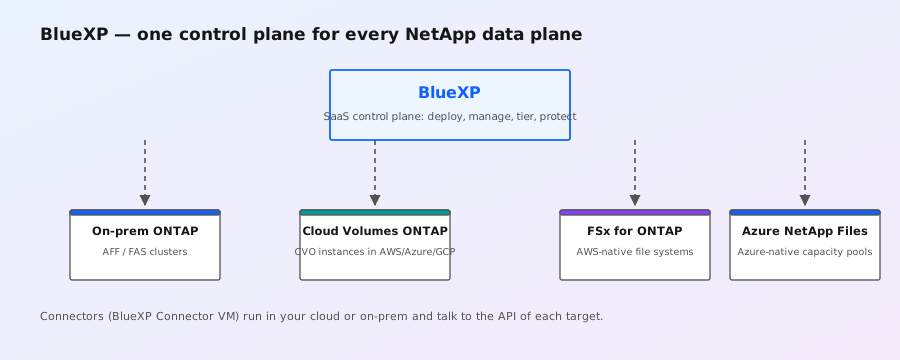
A Console user with on-prem ONTAP working alongside a Google Cloud NetApp Volumes (formerly Google Cloud NetApp Files) deployment reported that the Google agent tile shows a data-capacity summary icon but no drill-down to individual volumes — only on-prem ONTAP volumes render in the Console inventory. The expected behaviour from NetApp's Console/BlueXP documentation: Google NetApp Volumes IS supported in Console for inventory but the volume list lives in the Google Cloud NetApp Volumes tile inside Google Cloud Console, while the NetApp Console gives a top-line capacity/health view of the agent only. Workaround for full volume-level visibility: open the Google Cloud Console → NetApp Volumes → Volumes for the project, or call the NetApp Volumes API (`google.cloud.netapp.v1`) directly. As of mid-2026 NetApp is shipping a deeper Console inventory integration, so check the release notes before assuming this is still the case. Useful for hybrid customers planning Console as a single pane of glass.
Google Cloud NetApp Volumes Flex Unified is now a first-class citizen in Google Cluster Toolkit starting with release v1.102.0. The `netapp-storage-pool` and `netapp-volume` modules provision Flex Unified pools and volumes directly from a blueprint — including zonal and regional pools, large capacity (scale-out) pools, custom performance, and auto-tiering. Useful for EDA, HPC, and AI/ML workloads where Standard/Premium/Extreme service levels (which tie throughput to provisioned capacity at 16/64/128 KiB/s per KiB) force overprovisioning. Flex Unified breaks that link: pool capacity, throughput, and IOPS scale independently, plus features like zonal-or-regional pools, large capacity pools, auto-tiering with hot/cold split, sub-millisecond read latency, and broad regional footprint. Configurable pool knobs: `service_level: FLEX`, `scale_type: SCALE_TYPE_SCALEOUT`, `total_throughput_mibps` (1 MiB/s increments, default 64 MiB/s+1024 IOPS, scaling to 5 GiB/s+160k IOPS), `allow_auto_tiering: true`, `hot_tier_size_gib`, `enable_hot_tier_auto_resize`, `replica_zone` for regional pools. Volume module inherits from pool via `use: [netapp_pool]` (never set region/zone on volume). Large-capacity volumes use `large_capacity_config.constituent_count` (typically 48) with min 4800 GiB. Note: Flex pool names accept lowercase letters/numbers/underscores only — no hyphens. Standard/Premium/Extreme now require ≥15 TiB. Deletion policy: `PREVENT` to block Terraform deletion, `ABUNDANCE` for state-only removal. The post is the first end-to-end blueprint reference for Cloud NetApp Volumes Flex Unified; pairs well with EDA/HPC team onboarding.
Community deep-dive on the Trident 26.06 release, where the **concurrent core** controller architecture (originally a tech preview in Trident 25.06) reaches GA. With traditional Trident, all operations were serialized by a global lock; concurrent core removes that bottleneck so many provisioning requests can run in parallel. 26.06 extends the GA coverage to ONTAP-NAS-Economy, ONTAP-SAN-Economy, and Azure NetApp Files backends. Reported throughput gains from the NetApp benchmark: ONTAP NAS +707% (~8.1×), ONTAP NAS Economy +472% (~5.7×), ONTAP SAN iSCSI +449% (~5.5×), ONTAP SAN Economy +285% (~3.9×). Methodology is a large batch of operations submitted then timed to terminal state.
Community post (NetApp engineer Robert) addressing the common perception that Azure NetApp Files (ANF) is expensive versus other Azure storage options. The argument: **list price ≠ effective price**, and once you factor in ANF's tools for adjusting how capacity, performance, and data protection are billed based on actual access patterns (cool access tiers, capacity pools, thin provisioning, snapshot efficiency), the effective monthly cost frequently lands at parity with cheaper Azure storage while delivering enterprise data management, protection, and security those services can't match. The post walks through scenarios — paying hot-tier prices for cold data, paying for snapshots as full copies, paying for replication capacity twice — where ANF's tooling (cool access, snapshot savings, cross-region replication efficiencies) compresses the bill materially.
Co-authored community post (NetApp engineers RajivJain + ChanceBingen) on combining **SnapMirror Active Sync** with the new **ONTAP tools Granular Datastore Protection (GDP)** feature in ONTAP tools for VMware vSphere 10.6. GDP lets administrators pick specific VMFS-FC or VMFS-iSCSI datastores inside an ESXi host cluster and protect them with **zero RTO / zero RPO** SnapMirror Active Sync replication. Two host-proximity modes are described: **uniform** (each ESXi host can see the peered datastore at both sites) and **non-uniform** (hosts only see the local copy, with host-coordinated I/O redirection). Reported typical failover IORT is ~11 ms in the uniform case, environment-dependent. Workloads can actively use I/O from either side, so VMs can read/write from either location.
Community announcement (NetApp engineer sydamin) that **symmetric active-active SAN pathing** is being extended from NetApp ASA into **NetApp AFF unified systems** starting with **ONTAP 9.19.1**. Symmetric active-active gives simultaneous active-optimized LUN access across both controllers in an HA pair, with predictable I/O behavior and minimal path-transition delay on failover. The AFF extension specifically targets customers consolidating mission-critical SAN, NAS, and mixed workloads onto a single ONTAP platform — getting ASA-class SAN resilience alongside unified-protocol capability. The post explicitly differentiates AFF (unified consolidation) from ASA (SAN-only, single-purpose) — NetApp is sharpening rather than blurring the line.
Community post (NetApp engineer Rishikesh) following up on NetApp Harvest's role as a single collection layer across on-prem ONTAP and Google Cloud NetApp Volumes. New in this post: real-time (sub-5-minute) performance and health telemetry from GCNV pools is now exported directly into Google Cloud Monitoring, complementing the existing five-minute polling. The motivation is concrete — I/O microbursts that hit transactional databases get averaged out in 5-minute samples, masking the actual latency spike that triggered application timeouts. By the time the averaged data is visible, the customer-impact window has already passed. Harvest's per-second resolution surfaces transient bottlenecks as they happen.
NetApp community thread asking how to monitor per-volume capacity growth **and** which folders inside the volume are growing, not just the top-level volume growth that Active IQ Unified Manager reports weekly. OP mentions Active IQ gives volume-level growth only (no folder breakdown) and asks whether anyone uses the ONTAP REST API to script a custom monitor. Multiple responders note that Active IQ Unified Manager only gives coarse weekly growth with a limited retention window — not useful for trend analysis or alerting. A community suggestion is **qtree quota capacity reporting via Xormon** (third-party NetApp monitoring tool) as a workaround that exposes per-qtree capacity and growth rates. The thread is useful for any NetApp operator building capacity dashboards: it surfaces the real gap between what Unified Manager shows (weekly volume totals) and what storage admins actually need (folder/file-level growth trending with enough history to forecast).
A NetApp community question (answered) on the perennial capacity-monitoring problem: stay ahead of growing volumes *and* identify which folders inside each volume are growing. The asker notes that **Active IQ Unified Manager** gives volume-level growth but no folder-level drill-down, and wants to know what people use beyond that. Tags include FAS, CIFS/SMB, and Active IQ Unified Manager — the answer thread (6 comments, 19 views, marked **Answered**) discusses practical approaches such as the **ONTAP REST API** (`/storage/volumes` metrics, per-volume inode and capacity time-series), `volume efficiency` show commands, and **ONTAP File Analytics** / **XCP** for folder-level breakdowns. Discussion also touches **AIQUM** REST API endpoints that can be polled into a Grafana or observability stack.
Community technical evaluation (NetApp engineer kanikaj) of Oracle 19c Data Guard with Fast-Start Failover (FSFO) running on **Google Cloud NetApp Volumes (GCNV) iSCSI** storage, measured across four failure scenarios: planned switchover, instance crash, VM-level outage, and network partition. Headline results: **observed RPO = 0 in all four scenarios; observed RTO ≈ 45–58 seconds app-visible** when running in Zero Data Loss Mode. Validation uses Oracle's own System Change Number (SCN) commit-ordering record for two of the four scenarios — so the zero-data-loss claim is anchored in Oracle-internal evidence rather than just application logs.
Technical follow-up (NetApp engineer creeder) to the Trident 26.06 concurrency GA post — goes deeper into **how** the concurrent controller works internally. Trident orchestrates between Kubernetes resources (PVCs) and storage backends (ONTAP, ANF, etc.) with strict ordering requirements (e.g. FlexVol must exist before an export policy is attached on the ONTAP-NAS backend). The new design introduces a **concurrent cache** with hierarchical lock ordering — locks are always acquired and released in the same sequence, which prevents deadlocks while allowing many operations on different volumes to proceed in parallel. The post also references the broader pattern (hierarchical locks) used in databases and kernels for decades.
Community walkthrough (by NetApp engineer sajith) of mounting Google Cloud NetApp Volumes (GCNV) Flex Unified NFS volumes as **external NFS datastores** on Google Cloud VMware Engine (GCVE) clusters. Walks the prerequisites (active GCVE private cloud with at least one cluster, an existing Flex Unified storage pool), provisions an NFS volume, and mounts it as a datastore — works with both zonal and regional Flex Unified storage pools. The architectural pitch is that storage now scales independently of ESXi node count, so adding nodes purely to grow datastore capacity is no longer the only option, while ONTAP data services (snapshots, clones, replication) stay available behind the volume.
Field-engineer checklist thread from a NetApp customer planning a FAS50 jump from **ONTAP 9.16.1P7 → 9.17.1P10**. The trigger is an open mgwd-panic / controller-reboot defect (**CONTAP-621129**) for which the fix is only present in 9.17.1P10 — not in any 9.16.1 patch. The interesting part is the upgrade-validation matrix the user assembles around a real Oracle / SQL / Exchange estate protected by **SnapCenter 5.0 SP2 + SnapCenter 6.2P1** — components that already show up as **EOVS** in NetApp's Interoperability Matrix Tool (IMT) for 9.17.1. Pre-upgrade gating inventory: per-DB stack (Linux OS, Oracle version/RU, RAC vs standalone, ASM, FC vs iSCSI, plug-in versions), per-app host inventory (Windows Server, SQL Server CU/AG topology, Exchange DAG), confirmation that 5.0 SP2 and 6.2P1 are independent SnapCenter Servers, that all protected storage is on the same FAS50, and any SnapMirror/DR secondary ONTAP. Pre-flight commands cited: `Upgrade Advisor` plus shelf/disk firmware check, plus Host Utilities / MPIO / HBA driver+firmware / SAN switch firmware review. The open question is whether EOVS in IMT means SnapCenter 5.0 must be upgraded first, or whether the ONTAP 9.17.1 upgrade can proceed independently.
I have Netapp Console configure and can see my on-prem Netapp volumes fine. I have a google agent configured and it shows an icon of how much data there is in Google and how many volumes there are, but in the console, Im not able to see the volumes, is this expected? TIA, Todd
An application owner pings Anna on Teams: "We need 500 GB for a new service, today, if possible." She knows the drill. She opens NetApp® ONTAP® System Manager on the target cluster to check aggregates, Active IQ Unified Manager to see whether anything is already alerting on that system, and NetApp Digital Advisor® to confirm capacity trends look healthy, each tool doing exactly what it was built to do. The provisioning itself takes minutes.
Hi there, Apologies if this isn't the correct place to post this, however the ONTAP Simulate download page fails to provide a download link. Is there something I could be doing wrong?
All, Does the standard ONTAP base (FAS2820) include any immutability feature by default, or do I need ONTAP ONE to get WORM functionality and SnapLock licensed and enabled to ensure immutability? TIA.
I got the below error while running the .\Install.ps1 Any ideas how to fix this?tia#—————————————————————————————————————————————- Output running PWSH 7 as Admin PS E:\Library\Tech Vendors\NetApp\powershell.ontap\NetApp.ONTAP\NetApp.ONTAP .\Install.ps1 NetApp ONTAP PowerShell Toolkit Installer Running on: Windows (PowerShell 7.6.
Hybrid multicloud operations have reached an inflection point. For years, infrastructure teams have worked across disconnected tools, fragmented management planes, and environment-specific workflows to keep storage estates running. That model worked when estates were smaller, more centralized, and easier to reason about manually. But today, many organizations are operating dozens, or even hundreds, of clusters across on-premises environments, public clouds, sovereign clouds, and edge locations. At that scale, the operational unit is no longer the individual cluster.
Google Cloud NetApp Volumes Flex Unified is now a first-class citizen in the Google Cluster Toolkit . Starting with release v1.102.0 , the netapp-storage-pool and netapp-volume modules provision Flex Unified pools and volumes directly from a blueprint, including zonal and regional pools, large capacity (scale-out) pools, custom performance, and auto-tiering.
Hello, We are using the NetApp Shift Toolkit as part of a VM migration project (from VMware to Proxmox). I noticed that there are several “DRO” (Disaster Recovery Orchestrator) snapshots on the volumes. From my understanding, these are related to the Shift Toolkit, which creates a volume snapshot before converting the disks. It then creates a clone (FlexClone) to convert the disk format from .vmdk to .qcow2, without modifying the original virtual machine. These snapshots are consuming a significant amount of storage space (more than 18 TB! on flash array for few tests).
Reddit r/netapp discussion thread. Internal Job Switch. Auto-aggregated from public community sources. Refer to publisher for full content. Categorized as `community` for the NetApp Black Box library.
User troubleshooting: Google Cloud NetApp Volumes (GCNV) agent shows an icon in NetApp Console with only data-size info, but on-prem volumes show full inventory. Discussion covers NetApp Console agent permissions, GCV volume import vs. native agent mode, and known visibility gaps for GCNV/Native Flex/Aggr-block tiers. Relevant for admins running hybrid Google Cloud + on-prem NetApp deployments.
User running SnapLock Compliance on the ONTAP simulator runs into license/feature-pack errors configuring a SnapLock aggregate + log volume. Discussion covers the steps to enable snaplock on Sim (license add, snaplock create-volume privileged-delete) and known limits (ComplianceClock drift, no audit-log shipping). Good primer for hands-on SnapLock practice.
NetApp Trident 26.06.1 introduces Preview support for Google Cloud NetApp Volumes (GCNV) ONTAP-Mode (the full-ONTAP option, not just Flex). Discusses CSI driver provisioning, NFS/CSI topology constraints, snapshot/restore with TridentSnapshot, and how to migrate GKE workloads onto ONTAP-Mode. Pre-GA preview, so workflow details will evolve.
Announcement: Google Cloud NetApp Volumes Flex Unified is now a first-class option in the Google Cluster Toolkit. With release v1.102.0, the netapp-storage-pool / GKE integration supports Flex Unified for HPC/scale-out AI workloads. Includes a usage recipe for Slurm/GKE clusters and points to docs for mounting NFS volumes from Flex Unified for parallel training jobs.
Architecture discussion: snapshots/replication vs. cross-region DR vs. cross-account backup patterns for FSx for ONTAP. Walks through account-boundary considerations, AWS Backup vault locks, FSx for ONTAP's per-AWS-account quota, and NetApp SnapMirror Cloud as an alternative. Concrete patterns for regulated workloads needing DR outside the original AWS account.
NetApp Community discussion framing agentic AI in NetApp's product portfolio. Distinguishes marketing-defined AI agents (workflow automators with tool access) from true agentic systems (planning + memory + reasoning + execution). Useful context for evaluating NetApp AIPod, BlueXP AI/ML, AI Data Engine, and integration points where an AI agent could orchestrate ONTAP volumes/snapshots via the ONTAP REST API.
ONTAP A30 (AFF A30) node showing half its CPUs pegged at 100% in 'system node run -node ntap01-01 -command sysstat -m'. Discussion walks through diagnosing whether the load is wafl_exempt, nblade, or bplane, and what counter to pull (sysstat -c 50, perf-archive, wafl_iw, hya). Useful troubleshooting flow for NCDA/NCIE perf questions.
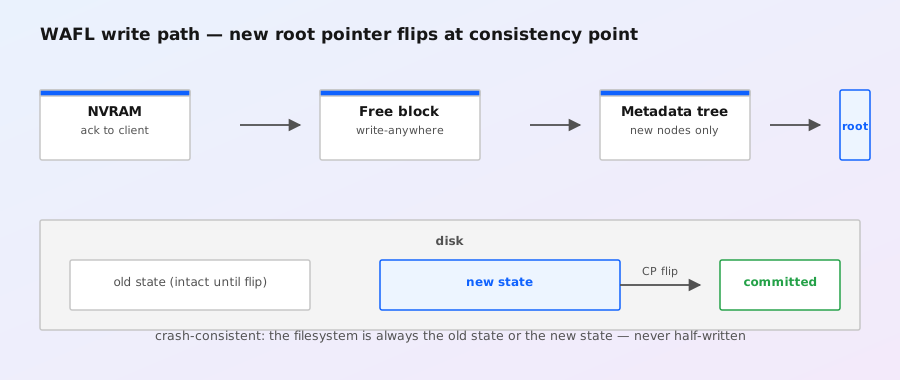
NetApp community thread where an AFF A30 customer reports persistent 100% CPU utilization on the **odd-numbered** cores in `sysstat` across 3 controllers, with minimal workload (mostly hourly SnapMirror destinations). NetApp engineer Jonathan Gaudette clarifies the architecture: the AFF A30 has **a single 16-core Xeon CPU with Intel Hyperthreading enabled**, so `sysstat` reports 32 logical processors — the apparent "odd-core" saturation is actually one of the two logical threads of each physical core being heavily used. He explains that newer ONTAP versions deliberately use as much CPU and RAM as possible for background tasks: **storage efficiency features (compression, dedupe, snapshots), WAFL free-block cleanup, filesystem metadata maintenance**, and (for SnapMirror destinations) replicating the source's storage-efficiency layouts. He warns against trusting AI-generated explanations of ONTAP sysstat that misattribute the load to "control vs data planes". The takeaway for operators: sustained near-100% CPU on AFF A-series is expected behavior under default efficiency settings — investigate only when it crosses into user-visible latency, not on raw utilization.
Reddit r/netapp thread on the AIQ Navigator release: customers reacting to the new Active IQ Unified Dashboard UX, discussing migration from classic Active IQ, troubleshooting tip requests around AIOps alerts, and surfacing feature gaps vs BlueXP. Useful first-impression feedback for anyone evaluating AIQ Navigator for an ONTAP fleet.
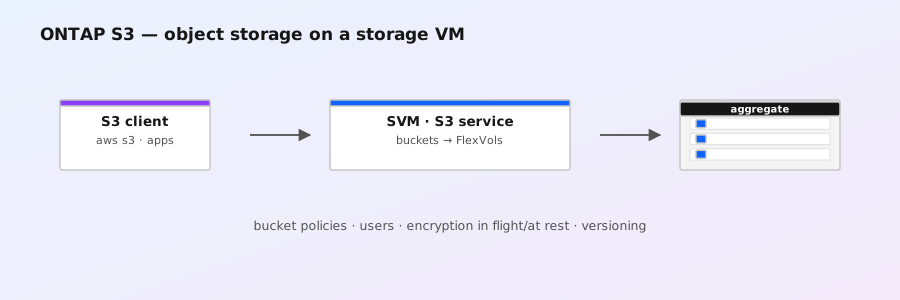
Reddit r/netapp thread on configuring StorageGRID ServerSideEncryption (SSE) on VMware deployments: practitioners walk through KMS server setup, KMS key rotation, and the relationship between S3 SSE-S3, SSE-KMS and SSE-C on StorageGRID. Includes troubleshooting notes for failed PUTs due to clock skew and a workaround for VMware vCenter KMS key-pinning limitations.
2026-08-30 — NetApp AI signal: competitors + community angle
Source: Multiple — see entries below
Three AI-relevant signals from this run, none of which are pure NetApp-blog content but together sharpen the AI Hub's competitive-and-community positioning.
Source: NetApp Community — https://community.netapp.com/community/discussion/468353/cross-region-and-cross-account-backup-for-amazon-fsx-for-netapp-ontap
NetApp Community walk-through of AWS Backup's new cross-account / cross-Region copy for Amazon FSx for NetApp ONTAP (announced 2026-08-27 by AWS). The post walks through four architecture patterns and a step-by-step: local backups → cross-Region copy → cross-account copy → organization-wide backup plans via AWS Organizations. Positions cross-account copies as a managed complement to Snapshot copies, SnapMirror, and FSx backups — not a replacement — and clarifies when each option protects against operator error, account compromise, or region loss.
Source: NetApp Community — https://community.netapp.com/community/discussion/468350/100-cpu-utilization-on-a30
Customer post on NetApp A30 nodes running flat at 100% CPU under what should be modest workload. Community + NetApp staff trace it to a specific subsystem (mhost / RAID / nbl process depending on the thread), identify workload-driven saturation versus a known issue, and recommend a perfstat collection + AutoSupport review before opening a case. Useful real-world trace for anyone operating AFF A30 / ASA A30 fleets at scale.
Source: NetApp Community Discussion — https://community.netapp.com/community/discussion/468349/agentic-ai-and-netapp
A NetApp Community thread exploring how agentic AI maps onto the NetApp stack — MCP-style agents invoking ONTAP operations, AI assistants surfacing storage telemetry, and how AIPod / NetApp Console / AI Data Engine fit an agent-driven enterprise AI story. Discusses agent governance concerns (read vs. write actions, RBAC), and what infrastructure primitives (snapshots, clones, SnapMirror) look like from an autonomous-agent perspective.
Source: NetApp Community (MarktheSpark, 3 comments, OGill active) · **Date:** 2026-08-24 · **Category:** community
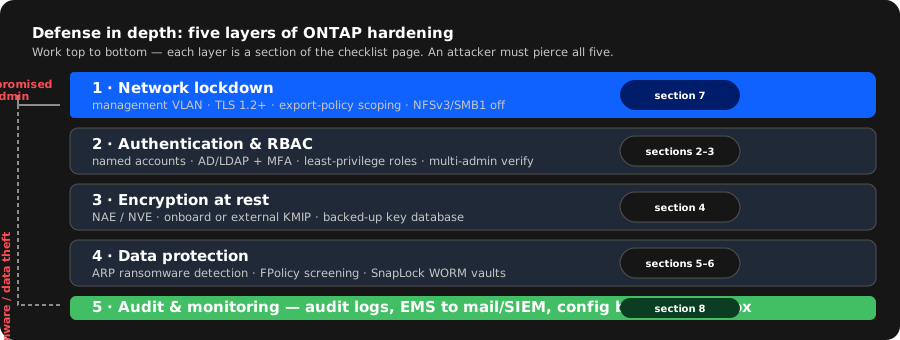
Admin investigation thread on enabling MFA via passkeys (WebAuthn) for ONTAP System Manager when systems use local accounts instead of AD — a deliberate design some shops take so that an Active Directory compromise doesn't cascade into storage management access. Thread covers feasibility of passkey-backed MFA on FAS/AFF local auth and its trade-offs; useful reference for security-hardening drives on air-gap-adjacent or reduced-AD-footprint environments.
Source: NetApp Community (JB) · **Date:** 2026-08-27 · **Category:** community
Fresh morning thread asking whether SnapLock works in the ONTAP simulator: the admin created a SnapLock aggregate, volume and compliance/enterprise log volume mirroring production settings. Relevant to lab planning — SnapLock WORM behaviors (retention clocks, compliance volume restrictions) validate differently on simulator hardware, so this is a good caution flag before rehearsing SnapLock runbooks purely in ONTAP Select-style labs.
Source: NetApp Community — https://community.netapp.com/community/discussion/468330/ontap-tools-for-vmware-vsphere-10-6-more-control-less-overhead-and-faster-day-2-operations
NetApp Community announcement / walk-through of ONTAP Tools for VMware vSphere (OTV) 10.6 — focused on vCenter 8 U3 alignment, more granular datastore control, less management-plane overhead, and faster day-2 operations (resizing, rebalancing, recovering VVols datastores). Adds improved vVols troubleshooting surfaces and an updated plug-in lifecycle for both vSphere 7 and 8.
NetApp community discussion on deploying StorageGRID virtual nodes in VMware vSphere environments with Server-Side Encryption (SSE-S3 / SSE-C). Practitioners exchanged configuration tips on integrating enterprise Key Management Servers (KMS) via KMIP, balancing encryption CPU overhead on virtualized StorageGRID nodes, and maintaining high throughput for S3 object workloads across hybrid cloud topologies.
A technical deep-dive from the NetApp homelab community on repurposing off-lease NetApp HCI H-series compute nodes (such as H410C and H610C). Storage engineers detailed the process of flashing generic Supermicro / Quanta BIOS and IPMI/BMC firmware onto the proprietary nodes, restoring full standard fan curve controls, IPMI remote console access, and compatibility with vanilla hypervisors like Proxmox VE and TrueNAS SCALE.
Source: AWS Database Blog via Google News — https://news.google.com/rss/articles/CBMi0AFBVV95cUxQczY4QnBVbHRGd1BRWVcyZUZvdnVGOXNnTkFZQWtFeC1HNVc1c2Y3LTNEVTlpdk1HYm5oRDJ0dlFCTUtoNlpWMWZCbW90cmxSQWJPQnFBQ25JLVRQaW02NldiMWVFN25mSjJHbkRvYW92LXJvS3ZvUXhxQjVPcHlqcEhYVjB0ZTdBb3NHdWZpUElKWl9odzVPZW9zTmRfOWJDUGhSb1B1UGxIVU5PTEEwb1N4SmFWVUZrR3FWaFYyNVNKOVV0UlJkUk4wVlFaVVpa?oc=5
AWS case study: S&P Global builds DR on FSx for ONTAP snapshots — a real-world example of ONTAP snapshot semantics (fast, space-efficient, application-consistent restores) carrying enterprise-grade recovery objectives in the cloud. Good reference material for DR design questions.