FLEXCACHE ONTAP 9.17.1P8 NFS ARCHITECTURE Oct 09, 2026
The incident pattern
NetApp’s case applies to AFF A800/A1K, ONTAP 9.17.1P8, FlexVol, FlexGroup, FlexCache and NFS. Two named workloads, WL1 and WL2, were running at about 16 Gb/s. Earlier FlexCache deployment used a multi-constituent cache in front of one FlexVol origin and was associated with remote-retrieve saturation, stripe or affinity contention, elevated NFS latency, mount failures, retrieve-failure storms and delayed SnapMirror replication. After workload redistribution, replication lag improved; the case says no user-visible CIFS/share latency was active at publication time.
That wording matters. The KB does not establish 16 Gb/s as a FlexCache ceiling, does not say every FlexVol origin will fail at that rate, and does not publish a replacement topology’s benchmark result. It documents a workload/topology interaction and asks whether FlexCache can safely be reintroduced.
Why the first cache did not remove the bottleneck
A FlexCache is a sparse FlexGroup. A file cached in a conventional multi-node FlexCache still lives in one constituent and therefore retains one volume affinity. Spreading client LIF connections across nodes may spread front-end sessions, but requests that land away from the constituent’s node traverse the cluster network. For a single very hot file, the servicing CPU remains concentrated and indirect access adds east–west traffic.
NetApp’s current hotspot-remediation documentation explicitly says an automatically provisioned, cluster-wide FlexCache can reproduce those two constraints. The proposed pattern is a high-density FlexCache array (HDFA): multiple caches of the same origin, each condensed onto as few nodes as capacity allows. Each HDF adds another cache copy and another volume affinity. A one-node HDF, paired with client access on that node, also removes the indirect cluster hop for that path.
| Topology | What scales | What can remain hot |
|---|---|---|
| One FlexVol origin | Client connections | Origin volume affinity and serving CPU |
| One auto-provisioned multi-node cache | Cache capacity and front-end reach | One cached copy of a hot file; indirect east–west access |
| Several dense HDFs | Cached copies and volume affinities | Origin coordination, cold misses, network and capacity limits |
The deployment decision is density, then client steering
NetApp expresses an HDFA as HDFs × nodes per HDF × constituents per node per HDF. In its four-node examples, a 2×2×2 layout creates two cache copies and gives an evenly distributed client a 50% chance of a node-local path. A 4×1×4 layout creates one HDF per node: four cached copies, four affinities and, when clients are correctly steered, no east–west traffic for the cached hot file. Those percentages are properties of the illustrated topology and even-distribution assumptions—not promised workload gains.
For NFS, NetApp documents two choices. An inter-SVM HDFA places each HDF in a separate SVM so every cache can use the same junction path; DNS round-robin can distribute mounts. An intra-SVM HDFA keeps HDFs in one SVM, requires unique junction paths and shifts more steering work to Linux autofs and deliberate data-LIF placement. SMB-only deployments keep the HDFs in one SVM and can use DFS targets. The network architecture guide is the companion design layer: broadcast domains, LIF locality, failover targets, MTU and switch paths determine whether the intended local path is real.
A safe reintroduction gate
- Freeze the baseline. Record per-workload throughput, protocol latency, NFS errors, client distribution, node CPU, volume affinity, cluster-interconnect load and SnapMirror lag before changing topology.
- Characterize reuse. FlexCache helps when clients repeatedly read the same hot data. Cold reads still retrieve from the origin; a streaming workload with little reuse can consume cache and origin bandwidth without delivering the expected hit benefit.
- Size from the working set. NetApp’s general guidance says a cache should be at least 10% of origin size, but that is a starting best practice, not proof that the active set fits. Estimate hot-set size, churn and headroom; ONTAP 9.8+ supports up to 100 caches per origin, subject to the documented node and constituent recommendations.
- Pilot one workload. Reintroduce WL1 or WL2, not both; cap the test, warm the intended files, and compare cold-cache and warm-cache behavior. Stop on rising protocol latency, retrieve failures, interconnect saturation or renewed replication lag.
- Prove degraded paths. Fail a data LIF and an HA partner in a maintenance window. Verify where clients reconnect and whether the failover converts a local path into an indirect one.
Use the site’s FlexCache reference for feature and lifecycle context, but treat this rollout as a performance change requiring NetApp support review. The KB’s mention of safe_sm0382 is incident context, not a tunable or a command for customers to change.
Where write-back does—and does not—fit
This case is about high-throughput caching and retrieve pressure; it does not say write-back is the remedy. Write-back, introduced for production use in ONTAP 9.15.1, changes when writes are acknowledged by committing them at the cache and flushing to the origin asynchronously. NetApp now strongly advises a current recommended release after ONTAP 9.17.1P1 for both ends, recommends at least 128 GB RAM and 20 CPUs per origin node, and warns that undersizing the origin can materially harm cache and origin performance. A read-hotspot design should not acquire write-back’s delegation, dirty-data and recovery considerations unless the write-latency use case requires them.
The finance read-through: signal, not revenue
There is no revenue, margin, guidance, AI mix or segment disclosure in this KB. The storage-customer read-through is narrower: NetApp is publishing architecture for a real high-throughput failure mode rather than implying that FlexCache is a one-click scale-out answer. That improves the operability story for EDA, rendering and AI data pipelines with concentrated hot files, but it does not quantify product demand.
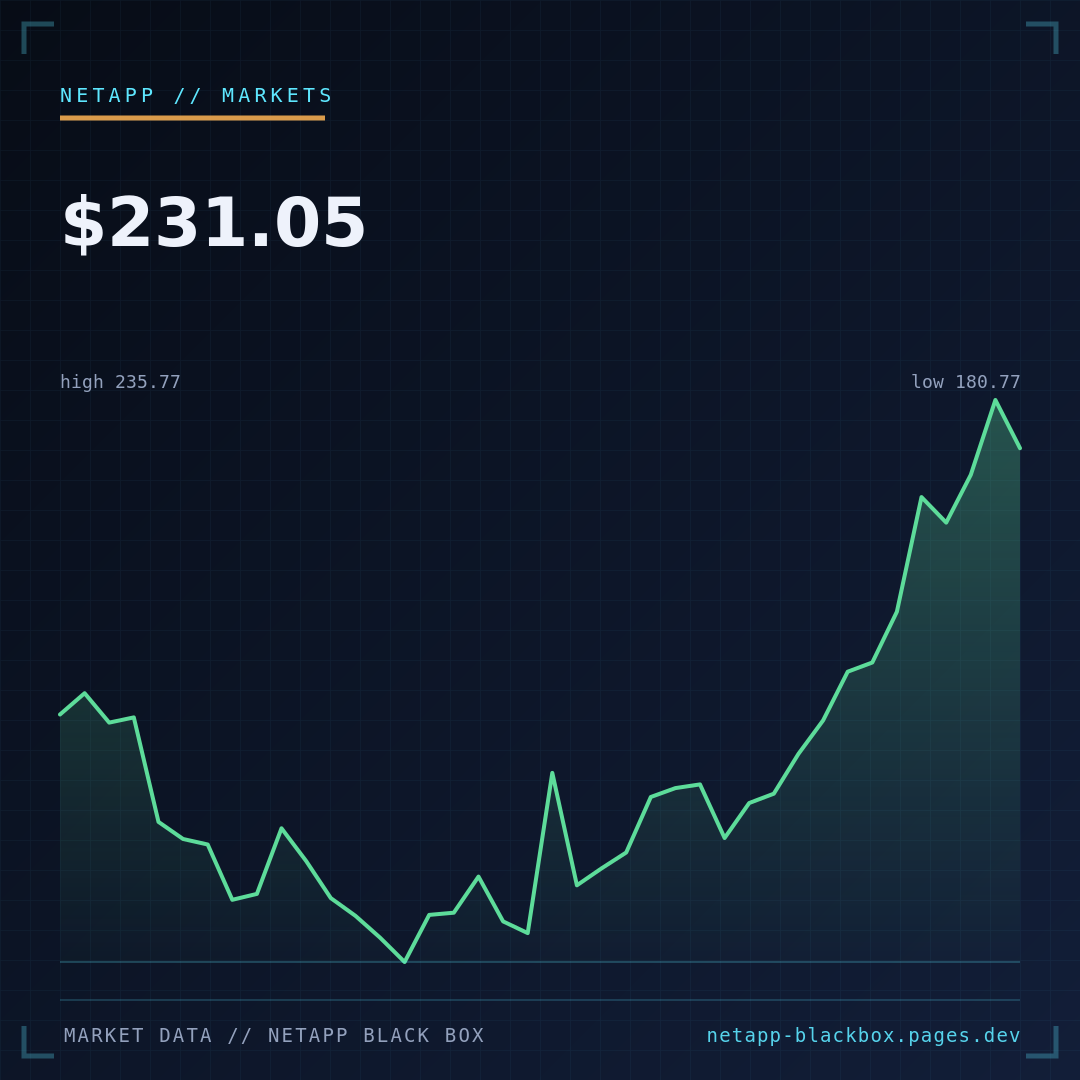
state/ntap_market.json, as of 2026-10-09 04:05Z). The series does not establish that this KB item caused any price move.The strongest financial evidence remains NetApp’s Q1 FY27 disclosure: $2.025 billion revenue, 30% year-over-year growth, $1.3 billion all-flash-array revenue (up 47%), $206 million public-cloud revenue (up 28%), and Q2 guidance for 23%–24% non-GAAP gross margin. NetApp did not disclose AI-only revenue or margin. FlexCache guidance may support retention and expansion inside high-performance file estates, but converting that into revenue requires adoption evidence that is not present here.
Bottom line
Do not ask whether “FlexCache supports 16 Gb/s.” Ask where the hot file lives, which CPU owns its volume affinity, how many independent cache copies exist, whether client mounts land on the matching node, and what happens to the origin and SnapMirror during misses. The KB’s useful contribution is to make the failed topology visible. The HDFA guidance supplies a design direction; only a measured, staged pilot can validate it for a specific estate.
NetApp KB: FlexCache architecture guidance · NetApp: FlexCache volumes management (PDF) · FlexCache reference · Network architecture