FlexCache on ONTAP
A FlexCache volume is a read cache of an origin volume that lives on other aggregates or a remote peered cluster: edge sites serve repeated reads at LAN speed while real-time invalidation keeps the cache coherent with the origin. This guide covers when it fits (and when it does not), the deployment runbook with real ONTAP 9.x CLI, sizing rules, monitoring, and troubleshooting.
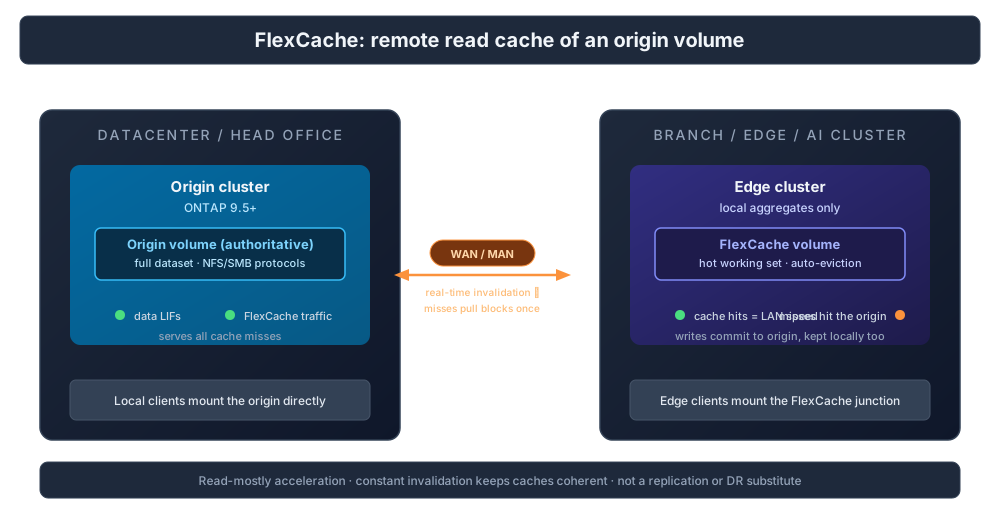
What FlexCache is — and what it is not
A FlexCache volume presents the same namespace as its origin volume, but blocks clients read are fetched from the origin only once and then served locally until invalidated. It is populate-on-demand, block-level, and coherent by design.
| FlexCache | SnapMirror | FabricPool | |
|---|---|---|---|
| Purpose | Accelerate reads close to users/GPUs | Copy data for DR/backup | Tier cold blocks to object storage |
| Writes | Committed to the origin; also kept in cache briefly | Replicated async/sync to target | N/A (tiering policy per temperature) |
| Cohesion | Real-time invalidation from origin → caches | Update interval (or sync mode) | Same aggregate namespace |
| Fills on demand? | Yes — blocks arrive on first miss | No — full baseline copy first | n/a |
| Protects data? | No — eviction can drop any cached block; origin remains authoritative | Yes | Extends capacity, not DR |
Key properties worth internalizing:
- Cache size ≠ origin size. A cache can be far smaller than the origin; keep the hottest working set resident. Eviction makes room automatically as new data streams in.
- Invalidation is push-based and prompt. When a client modifies data through the origin (or another cache), the origin tells every cache immediately — you are not betting on a TTL.
- Namespaces join seamlessly. Clients mount the FlexCache junction path exactly like the origin; exports, qtrees, permissions come along.
- Origin stays authoritative for writes. Writes arriving at a cache are forwarded/committed at the origin, then retained locally too — remote write latency still includes the WAN hop.
Where FlexCache shines (and where it backfires)
Good fits:
- Branch offices consuming headquarters media/CAD/VFX assets — big sequential re-reads over a lossy WAN disappear after first pass.
- AI training datasets near GPUs — training re-reads the same samples for many epochs; a cache co-located with the GPU cluster turns epoch 2+ into local reads instead of hammering the origin NAS across campus/WAN. (Different job than KV-cache offload to storage — see the news piece on NVIDIA inference spills.)
- HPC / EDA build & scratch trees — many nodes reading identical toolchains and datasets concurrently.
- Offloading fan-out reads — dozens of readers whose aggregate throughput would saturate one origin filer even on LAN.
Bad fits:
- Write-heavy or streaming-once data (CCTV ingest, logging sinks) — poor re-read ratio means every byte crosses the WAN anyway plus overhead.
- Using it as backup or DR — evicted blocks simply do not exist on the edge anymore.
- Random-read-once patterns where hit rates stay near zero — you pay the invalidation/management tax for nothing.
- Files mutated constantly everywhere — churn triggers constant invalidation traffic; consider syncing differently or redesigning workflow locality.
Prerequisites & design decisions
Checklist
- ONTAP version support: next-generation FlexCache appeared in ONTAP 9.5; NFS origins are the classic case, FlexGroup origins arrived later (9.7-era), and same-cluster caching (no peering needed) is supported in modern releases. SMB-origin specifics vary by release — check your release notes before promising Windows client acceleration.
- Origin and edge clusters must be peered when they differ (cluster-level peer relationship; intercluster LIFs on both sides). Intercluster traffic uses TCP 10000/11104/11105 — mirror your firewall plan accordingly (port reference).
- Aggregates on the edge with enough free space; cache volumes are normal thin-provisioned FlexVols underneath.
- Licensing: FlexCache is licensed separately (on-prem) — confirm entitlement before deploying at scale.
Sizing guidance
- Size to the working set, not the dataset. Ask: how much data will be re-read within an hour/day? That window should fit comfortably in the cache. If cache = 10% of origin but holds 80% of reads, that is a win.
- Too small hurts twice: thrash forces re-fetches AND floods the origin that you were trying to protect.
- Spread across aggregates. Let auto-provisioning distribute chunks; on large edges prefer several smaller caches? No — fewer, bigger caches simplify management. Use
-auto-provision-cluster-mode trueand let ONTAP place chunks across node pools for bandwidth balance. - Do not enable inline dedupe/compression on the cache itself expecting savings — hot duplicate blocks mostly exist once already; efficiency features behave differently than on write-heavy vols.
Step-by-step deployment runbook
1 — Verify cluster peering (remote-origin case)
# On BOTH clusters: peer must be healthy, IC LIFs up
cluster peer show
network interface show -role intercluster

# Confirm application authorization exists (or add it)
cluster peer show -instance <peer-cluster-name>
If not yet peered, follow the Cluster & SVM Peering guide: generate passphrases, create peer relationships with IC LIFs on both clusters, verify with cluster ping-cluster.
2 — Create the FlexCache volume (edge side)
# Edge cluster: cache of an origin on the peered cluster
volume flexcache create \
  -vserver            svm_edge \
  -volume             fc_media_cache \
  -aggregate-list     aggr1_node1,aggr1_node2,aggr2_node3,aggr2_node4 \
  -size               2TB \
  -origin-vserver     svm_hq \
  -origin-volume      media_library

# Simpler: let ONTAP spread chunks across a cluster-wide pool
volume flexcache create -vserver svm_edge -volume fc_build_cache \
  -auto-provision-cluster-mode true -size 5TB \
  -origin-vserver svm_hq -origin-volume toolchain_nfs

# Same-cluster cache (edge == origin cluster): no peering needed
volume flexcache create -vserver svm_hq -volume fc_local_hot \
  -auto-provision-cluster-mode true -size 1TB \
  -origin-vserver svm_hq -origin-volume project_files
The command returns quickly (control path); initial population happens lazily as clients read. Namespace, exports, and qtrees appear immediately under the same junction structure as the origin.
3 — Mount and test from a client
showmount -e svm_edge.example.com        # junction paths visible?
mkdir -p /mnt/media && mount -t nfs svm_edge.example.com:/media_library /mnt/media

# First read of a large file = miss (crosses WAN); second read = LAN-speed hit
dd if=/mnt/media/dataset/big.bin of=/dev/null bs=1M count=10000   # slow-ish
dd if=/mnt/media/dataset/big.bin of=/dev/null bs=1M count=10000   # much faster
4 — Verify the cache is doing its job
# Instance-level view: state, origin mapping, per-cache details
volume flexcache show
volume flexcache show-instance

# From the ORIGIN side: which caches consume me?
volume flexcache origin show
volume flexcache origin show-cache-stats -vserver svm_hq -volume media_library

# Hit-rate counters: discover available objects, then watch them
statistics catalog counter show | grep -i flexcache
statistics show -object flexcache -interval 5 -iterations 6

# Latency split (local vs origin-served components)
qos statistics volume latency show -vserver svm_edge -volume fc_media_cache
Healthy signatures: flexcache_reads-family counters climbing faster than remote-fetch counters over time; QoS latency histograms for the cache volume staying well below what WAN RTT would inject.
5 — Manage lifecycle
# Find caches nobody has used lately (run on origin, ONTAP 9.10+)
volume flexcache report-idle-caches -idle-days 30

# Grow a busy cache (online)
volume size -vserver svm_edge -volume fc_media_cache -new-size 4TB

# Decommission cleanly: delete from the CACHE side
volume flexcache delete -vserver svm_edge -volume fc_old_cache
volume flexcache origin show # origin confirms it dropped out- Deleting a cache never touches origin data — but it destroys every un-evicted edge copy instantly (that is the point).
- Origin-side deletion attempts fail politely while child caches exist; remove caches first.
REST API equivalents (ONTAP 9.10+)
Automation-friendly sites can do this without SSH. Discover and act via the ONTAP REST API from the edge cluster management IP:
# List existing FlexCache volumes (filter by type)
curl -sku admin https://192.0.2.20/api/storage/volumes?type=flexcache\
  -H "Accept: application/hal+json"

# Create (same fields as the CLI; origin referenced across the peer)
curl -sku admin -X POST https://192.0.2.20/api/storage/volumes \
  -H "Content-Type: application/json" \
  -d '{"name":"fc_ci_cache","svm":{"name":"svm_edge"},
       "aggregates":[{"name":"aggr1_node1"},{"name":"aggr2_node3"}],
       "size":2147483648000,
       "flexcache":{"origin":{"volume":{"name":"toolchain_nfs"},
                                 "svm":{"name":"svm_hq"}}}}'

# Job status returned in the POST response (poll with the job URL/job.uuid)
See the ONTAP REST API automation guide for auth patterns, error bodies, and pagination conventions.
Tuning & operational gotchas
- Invalidation is constant, not periodic. If origin churns writes constantly, messaging overhead scales with change rate — another reason write-heavy origins are anti-patterns.
- Read-ahead helps sequential scans. For media/AI workloads (large sequential re-reads), let default read-ahead do its thing; pathological random small-file trees (email stores, compile outputs written fresh each run) gain little.
- Watch WAN loss for initial fills. Big first-pass files suffer TCP window effects on lossy links between origin IC-LIFs and edge; schedule warms during quiet hours with
dd/read loops if predictability matters. - Eviction means unpopularity. Blocks not recently read get reclaimed first; monitor effective hit ratio rather than assuming yesterday's warm set persists forever.
- Efficiency defaults differ. Do not clone your origin's dedupe/compression policies onto the cache verbatim — cross-check what the release supports on FlexCache volumes before assuming parity.
- Performance floor of misses = origin + WAN. A cache cannot beat physics: p99 on cold data still costs origin queueing + RTT.
- Kubernetes/Trident note: NFS backends can point clients (via Trident static PV) at a cache junction just like any export — but understand eviction/invalidation interplay with RWX workloads doing partial rewrites before committing CI pipelines to it (Trident guide).
Troubleshooting matrix
| Symptom | Diagnostics | Likely cause / fix |
|---|---|---|
volume flexcache create fails with peering/application error | cluster peer health show; cluster peer show -instance | Peer relationship missing, unhealthy IC LIFs, or FlexCache application not authorized — repair peer, ensure LIFs home correctly, re-run create. |
| Create fails asking about aggregates | volume flexcache show-instance; storage aggregate show-space | Explicit -aggregate-list too small/not enough free space — provision more aggrs or switch to -auto-provision-cluster-mode true. |
| Junction visible but client mounts hang on first file | statistics show -object flexcache; check origin-side volume flexcache origin show | Cache cannot reach origin (routing/firewall on IC path, wrong IPsace). Fix connectivity; verify with cluster ping-cluster -node <edge-node>. |
| Hit rate stays ~0% | volume flexcache origin show-cache-stats; workload profiling | Working set truly doesn't repeat (stream-once/write-heavy) — wrong workload for cache; remove it or repoint clients. |
| Edge reads fast all week, suddenly crawl | event log show -message-name *flx* -node *; qos statistics volume latency show | Working set exceeded cache size → thrash eviction cycle, or origin degradation shifting cost of every miss upward. Resize cache; check origin health. |
| Client sees stale-looking attribute seconds after someone rewrote file | Compare origin vs cache path directly; check EMS on origin for invalidation warnings | Rare: invalidation message missed under severe network disruption. Re-trigger the lookup from the client (ls/re-open) or restart NFS service at off-hours if persistent. |
| Want to delete cache but volume flexcache delete warns busy | volume show -volume X -fields files,mount-junction-path; vserver show-mounts equivalent via network connections active show | Live client handles on the cache junction. Unmount clients, then delete; last resort follow KB procedure for forced cleanup — never force-delete blindly on prod. |
FAQ
- Can I cache an SVM-root or DP volume?
- No — origins are regular read-write data volumes. SnapMirror destinations make bad origins precisely because their blocks churn via resync.
- Does the client need special software?
- No. Plain NFS against the edge junction; nothing kernel-side changes vs mounting the origin, because protocol surface is identical.
- What happens when the origin goes down?
- For stretches, previously cached (not-yet-invalidated) data may continue serving depending on release/flags, but correctness demands treating origin outage as cache-read-only-at-best. Do not architect around surviving origin loss with FlexCache — that is what MetroCluster/SnapMirror Business Continuity are for (MetroCluster guide, SM-AS guide).
- How many caches per origin?
- Platform/release-dependent limit — check your release's Maximum Limit Numbers. Plan fan-out explicitly rather than discovering the ceiling mid-rollout.
- SnapMirror my cache volume elsewhere?
- Nonsensical: cache contents are transient by definition. Mirror the origin instead; edge caches rebuild naturally when relaunched against the mirror (tiering reference covers a different cold-data pattern entirely).
Related pages
- FlexGroup deep-dive — scale-out origins and how caches compose with them
- Cluster & SVM Peering — trust fabric under every remote-origin cache
- FabricPool cloud tiering — capacity play vs FlexCache's performance play
- Network port reference — IC-LIF firewalls for cache↔origin traffic
- REST API automation guide — flexcache endpoints + polling pattern