FINANCE NTAP KEYSTONE 2026-10-31
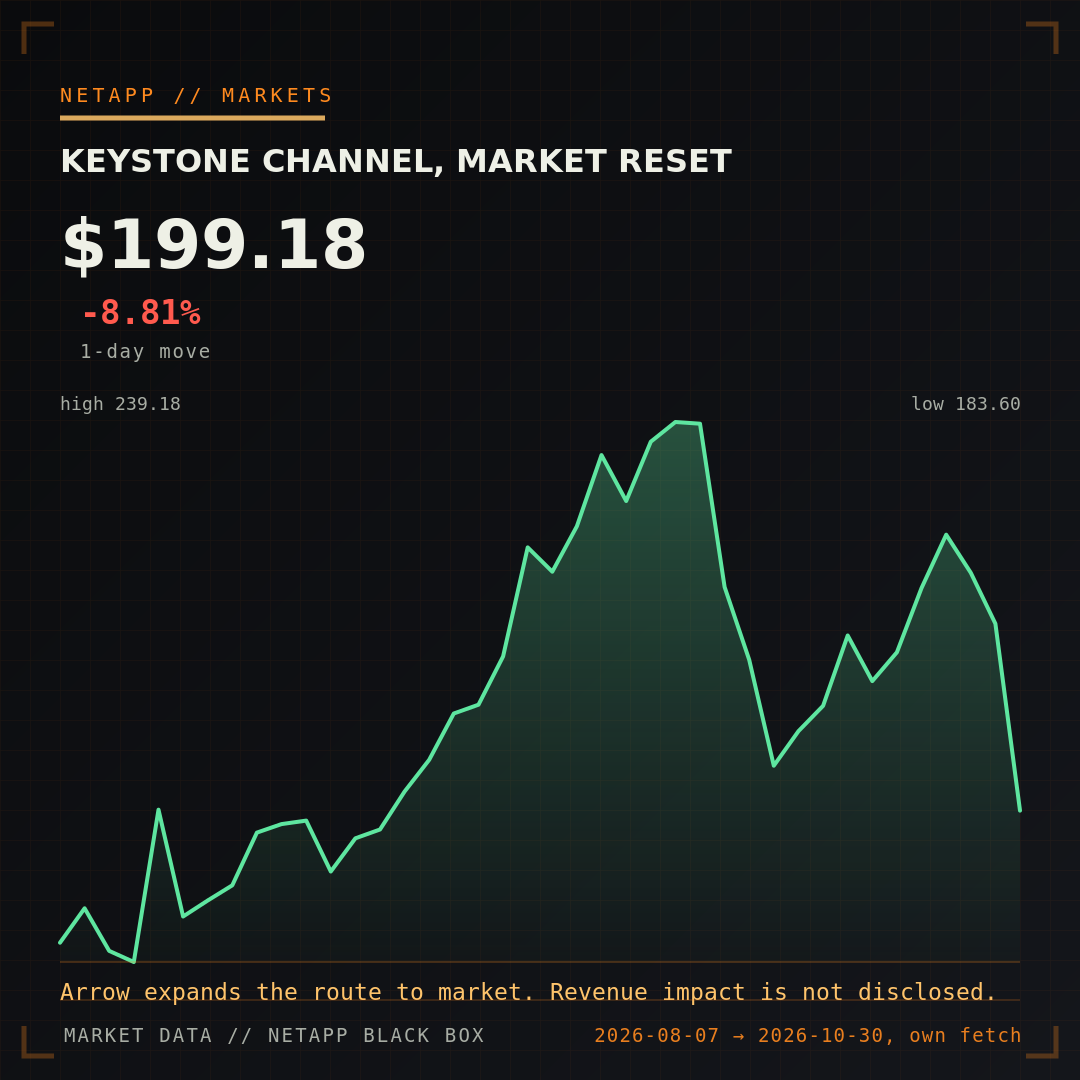
state/ntap_market.json; no publisher chart is reproduced.What Arrow actually launched
Arrow Electronics made managed storage services for NetApp Keystone available to channel partners and managed service providers. Arrow describes itself as the first distributor to offer the service. The offer uses Partner XaaS with NetApp Keystone and adds end-to-end lifecycle management, proactive monitoring and operational support, plus continuous optimization through NetApp Data Infrastructure Insights.
This is a distribution and operations change, not a new array or ONTAP release. Arrow is packaging a managed layer around the existing consumption-based Keystone offer so partners can sell a service without building every monitoring, support and lifecycle function themselves. The announcement supplies no price, revenue commitment, customer count or forecast.
The tape does not prove a Keystone reaction
NTAP closed October 30 at $199.18, down 8.81% from $218.42. The independently fetched series shows a 7.56% five-session decline, a 7.38% one-month decline, an 8.89% three-month gain and a 79.81% year-to-date gain. The close was 17.31% below the $240.87 52-week high.
Those observations provide scale, not attribution. A channel announcement with no disclosed bookings, economics or guidance change cannot by itself explain a daily market move. The defensible interpretation is narrower: the launch expands a route to market for Keystone while NTAP’s valuation was repricing from a strong year-to-date run.
The numbers behind the business
NetApp’s latest filed quarter, Q1 FY27, produced $2.025 billion of revenue, up 30% year over year. Hybrid Cloud revenue rose 30% to $1.819 billion, while Public Cloud revenue rose 28% to a record $206 million. Product revenue was $987 million, support was $720 million, and professional and other services were $112 million.
GAAP gross profit of $1.419 billion implies a 70.1% consolidated gross margin. GAAP operating margin was 23.9%, versus 31.9% non-GAAP. Cash is the counterweight: operating cash flow fell 25% to $503 million and free cash flow fell 35% to $401 million. Keystone revenue is not reported as a separate segment, so the filing does not let readers calculate this channel launch’s revenue or margin contribution.
Guidance is the measurable test
Management guided Q2 FY27 revenue to $2.025–$2.175 billion, GAAP gross margin to 66.0–67.0% and GAAP operating margin to 24.9–25.9%. Full-year guidance called for $7.975–$8.225 billion of revenue, 67.1–68.1% GAAP gross margin and $9.73–$10.03 of non-GAAP EPS.
Arrow’s launch did not change that guidance. Future evidence would be partner-sourced bookings, Keystone total contract value, subscription revenue or management commentary that ties channel expansion to results. None was included in the announcement.
AI demand: strong flash signal, no AI revenue line
All-flash array revenue reached a record $1.309 billion, up 47% year over year, faster than total company growth. That supports a broad high-performance data-infrastructure demand signal. It does not isolate AI: all-flash systems also serve databases, virtualization, consolidation and other enterprise workloads, and NetApp does not report AI revenue as a segment.
The Keystone channel move is therefore an access and operating-model story, not direct proof of incremental AI demand. It could make consumption-based infrastructure easier for partners to deliver to AI customers, but the announcement provides no AI workload mix, capacity under management or conversion data.
Read-through for storage customers
Customers evaluating the managed offer should separate three responsibilities: what NetApp supplies under Keystone, what Arrow operates, and what the channel partner remains accountable for. Put monitoring ownership, escalation paths, change windows, data access, capacity commitments, burst treatment, service-level remedies and exit obligations in writing.
Start with the Keystone reference for the consumption model and operator boundaries. Then ask for the exact DII telemetry path and retention policy, the supported configuration, who approves ONTAP changes, and how service data is exported at contract end. A managed wrapper can reduce operational load; it does not remove the need to test recovery, performance and governance.
Bottom line
Arrow’s launch gives NetApp a broader managed-services route to market for Keystone, but it supplies no new product, contract economics or revenue forecast. NetApp’s filed results show strong revenue and all-flash growth alongside weaker cash flow; the AI-specific and Keystone-specific mixes remain undisclosed. For customers, the useful question is not whether NTAP was “in focus,” but exactly where operational accountability moves under the managed service.
Sources: Yahoo Finance item via Google News · Arrow service announcement · NetApp Q1 FY27 results · NetApp Form 10-Q. Returns and margin calculations are NetApp Black Box analysis from the cited inputs and state/ntap_market.json. Not investment advice.