NetApp Keystone Flexible Consumption Guide
Understand NetApp Keystone Storage-as-a-Service: committed and burst capacity, service levels, subscription economics, platform choices, cloud alternatives, and operational tradeoffs.
What Keystone is
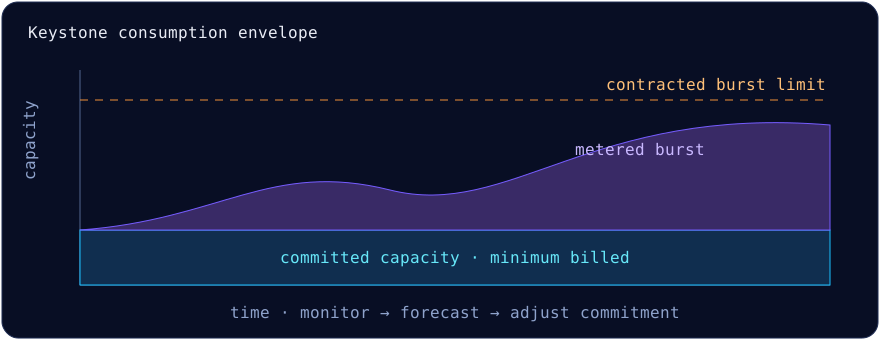
NetApp Keystone Storage-as-a-Service is a subscription-based, pay-as-you-go model for customers preferring operating expense over buying or leasing storage. Infrastructure, core software and support are packaged into capacity-priced performance service levels. It is not pure pay-only-for-use: committed capacity is the billed minimum.
Committed, consumed and burst capacity
Each performance service level instance has committed capacity. Consumption above it is burst capacity and is billed according to the order. NetApp documents a typical 20% burst limit, with 40% or 60% add-ons for eligible unified and block-optimized storage. Terms, waiver periods, minimums and change rules evolve; the signed order controls.
minimum = committed_TiB × committed_rate
variable = daily_average_burst_TiB × burst_rate
monthly_bill = minimum + variable
warn when consumed_TiB / committed_TiB >= 0.80
escalate when consumed_TiB > committed_TiB
forecast = current_TiB + growth_rate × months_remainingService levels and delivered systems
Current docs organize Keystone by unified, block-optimized, AFX, object and cloud storage. Unified levels map to AFF A-Series, AFF C-Series and FAS; block-optimized levels map to ASA A/C-Series; object levels use specified StorageGRID appliances; cloud includes Cloud Volumes ONTAP. E-Series has appeared in broader Keystone positioning, but eligibility is commercial—verify the current quote. Legacy labels such as Flex Subscription, FCP or FSC should not be mapped to current offers without NetApp confirmation.
See StorageGRID, hardware lineup and BlueXP/CVO.
Purchase versus subscription
| Dimension | Purchased ONTAP | Keystone |
|---|---|---|
| Spend | CAPEX plus support | Term OPEX; committed minimum plus burst |
| Ownership | Customer asset | Service infrastructure under contract |
| Growth | Buy headroom | Monitor burst and request increments |
| Refresh | Customer lifecycle project | Service terms govern lifecycle |
Decision matrix
| Need | Starting point |
|---|---|
| On-prem capacity, consumption billing | Keystone |
| Customer-controlled ONTAP VM in AWS/Azure | Cloud Volumes ONTAP |
| AWS-managed ONTAP file service | FSx for ONTAP |
| Azure-native file service | Azure NetApp Files |
| Hybrid commercial umbrella | Keystone plus eligible cloud service; verify regions/terms |
Pros, cons and administration
Benefits include predictable baseline spend, burst headroom and a bundled lifecycle. Tradeoffs include paying the commitment when underused, variable invoices during sustained burst, minimum-capacity rules and contract constraints.
- Alert at 80% of commitment and before the burst limit.
- Forecast per site and performance service level.
- Separate logical, physical, committed, consumed and billed capacity.
- Define ownership for overage, expansion, networking, data protection and support.
- Review snapshots, thick provisioning and object ILM because measurement differs by storage type.