ONTAP for VMware vSphere
A practical, breadth-first map of the storage choices beneath vSphere: NFS and VMFS data paths, VAAI offloads, VVol policy plumbing, protection, layout, performance, and the checks that restore a disconnected datastore.
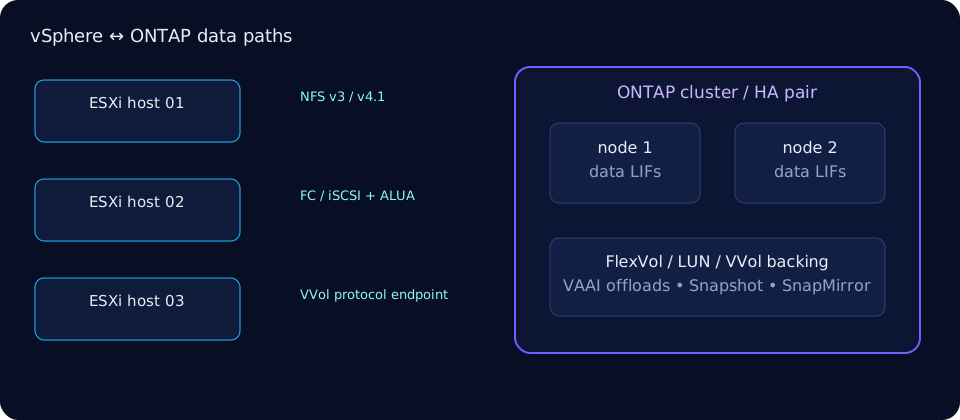
Choose a datastore protocol
ONTAP supports vSphere through NFS datastores and block datastores on FC or iSCSI LUNs. NFSv3 is simple and widely deployed; ESXi mounts each datastore through one logical NFS connection. NFSv4.1 adds sessions and multipathing support in vSphere, but all data LIFs used by a session must be reachable and consistently configured. Confirm the exact ESXi interoperability matrix before choosing a version.
| Choice | Strength | Design cost |
|---|---|---|
| NFSv3 | Operationally simple; mature VMware support | Design multiple datastores/LIFs to spread connections |
| NFSv4.1 | Session trunking and multiple paths when supported | Kerberos and path behavior require careful version checks |
| VMFS on FC/iSCSI | Block semantics and mature guest clustering options | LUN mapping, zoning/VLANs and host multipathing |
| VVol | Per-VM storage objects and policy-based management | Depends on VASA Provider and protocol endpoints |
cluster::> vserver nfs modify -vserver svm_vmware -v3 enabled -v4.1 enabled
cluster::> vserver nfs show -vserver svm_vmware -fields v3,v4.1
vserver     v3      v4.1
----------- ------- -------
svm_vmware enabled enabled
esxcli storage nfs41 add -H 10.20.30.41 -s /vmware_ds01 -v ds_nfs41_01 -a AUTH_SYS
esxcli storage nfs41 list
Volume Name Host(s) Share Accessible
ds_nfs41_01 10.20.30.41 /vmware_ds01 trueVMFS over iSCSI or FC
Create a volume, create a VMware-type LUN, then map it to an initiator group containing the ESXi initiators. Keep at least two independent target paths. ONTAP reports ALUA access states: paths through the node that owns the LUN's volume are optimized; partner paths remain usable but non-optimized. VMware's NetApp SATP rules normally select Round Robin—verify rather than assume.
cluster::> volume create -vserver svm_san -volume vmfs01 -aggregate aggr1 -size 4TB
cluster::> lun create -vserver svm_san -path /vol/vmfs01/vmfs01.lun   -size 3.5TB -ostype vmware -space-reserve disabled
cluster::> lun map -vserver svm_san -path /vol/vmfs01/vmfs01.lun -igroup esxi_prod
  (command completed successfully)
esxcli storage nmp device list -d naa.600a0980...
Storage Array Type: VMW_SATP_ALUA
Path Selection Policy: VMW_PSP_RR
esxcli storage nmp path list -d naa.600a0980...
... State: active, Target Transport Details: AOSee the SAN multipathing guide and network and port reference for end-to-end path validation.
VAAI hardware offloads
vSphere can ask ONTAP to perform storage work instead of moving every byte through ESXi. For VMFS, ATS arbitrates metadata updates, XCOPY accelerates compatible clones/copies, WRITE SAME offloads block zeroing, and UNMAP returns deleted thin-provisioned blocks. NFS VAAI support is delivered through the NetApp NFS plug-in and depends on compatible ONTAP Tools and ESXi releases.
esxcli storage core device vaai status get -d naa.600a0980...
VAAI Plugin Name: VMW_VAAIP_NETAPP
ATS Status: supported
Clone Status: supported
Zero Status: supported
Delete Status: supported
Thin provision both deliberately: monitor aggregate and volume headroom, and confirm UNMAP reaches ONTAP before counting reclaimed space.
VSC, VASA Provider and VVols
ONTAP Tools for VMware vSphere includes the management plug-in historically called VSC and a VASA Provider. VASA advertises array capabilities to vCenter. A storage container is the policy boundary backed by ONTAP storage; vCenter presents it as a VVol datastore. Each VM component becomes a VVol, while ESXi sends data through a small protocol endpoint rather than mapping every backing object as a conventional LUN.
cluster::> lun show -vserver svm_vvol -fields application,ostype
vserver  path                         application ostype
-------- ---------------------------- ----------- ------
svm_vvol /vol/vvol_pe/vvol_pe.lun vvol vmware| Dimension | VVol | VMFS |
|---|---|---|
| Policy granularity | VM/disk objects | Datastore/LUN |
| Management dependency | VASA Provider required | Works without VASA |
| Snapshot/clone alignment | Native per-VM objects | Datastore contains many VMs |
| Operational familiarity | More components to monitor | Long-established workflow |
Use the ONTAP Tools guide for appliance deployment and registration.
SDRS, snapshots and replication
Storage DRS balances placement inside a datastore cluster. Treat latency and space thresholds as guardrails; automatic moves can collide with backup, replication and peak windows. NetApp Snapshot copies are crash-consistent unless a backup product coordinates guest/app quiescence through VMware APIs. VASA reports storage awareness; it is not itself a backup engine.
Array replication with SnapMirror moves storage-efficient ONTAP copies and fits storage-led recovery. vSphere Replication protects VM disks at the hypervisor layer and can target unlike storage. Choose by recovery orchestration, RPO and failure domain; see backup and restore.
cluster::> volume snapshot create -vserver svm_vmware -volume vm_ds01 -snapshot pre_patch
cluster::> volume snapshot show -vserver svm_vmware -volume vm_ds01
Vserver      Volume   Snapshot        Size
------------ -------- --------------- -------
svm_vmware   vm_ds01  pre_patch       124MB
Layout and performance checklist
- Separate noisy swap/scratch traffic when its lifecycle or policy differs; do not place it somewhere that defeats VM recovery expectations.
- Use thin provisioning with capacity alerts and tested reclamation.
- For NFS use TCP and hard mounts. A Linux-style intent is
proto=tcp,vers=4.1,hard; in ESXi configure equivalent datastore settings through supported UI/CLI rather than copying Linux mount syntax. - Spread datastores and sessions across data LIFs; measure ESXi queueing and ONTAP latency together.
- Use jumbo frames only when every hop—including ESXi vSwitch/vmkernel, switches and ONTAP ports—shares the MTU. A partial jumbo path causes loss, not speed.
vmkping -I vmk2 -d -s 8972 10.20.30.41
PING 10.20.30.41: 8972 data bytes
9000 bytes from 10.20.30.41: icmp_seq=0 ttl=64 time=0.31 ms
Troubleshooting
| Symptom | Checks | Likely action |
|---|---|---|
| Datastore disconnects | vmkernel path, LIF status, export policy, MTU | Restore reachability before remounting |
| NFS permission/error | Export rule client match, protocol, security flavor | Correct rule; never open exports blindly |
| VVol protocol endpoint offline | VASA Provider health, certificate, PE paths | Restore provider/path and rescan |
| ALUA paths wrong/dead | igroup, SLM reporting nodes, zoning/VLAN, SATP | Repair path inventory; rescan host |
cluster::> network interface show -vserver svm_vmware -status-oper down
Vserver     Logical Interface Status Address
----------- ----------------- ------ ---------
svm_vmware nfs_lif_02        down   10.20.30.42
cluster::> export-policy check-access -vserver svm_vmware -client-ip 10.20.30.21   -volume vm_ds01 -authentication-method sys -protocol nfs4 -access-type read-write
Policy    Rule  Access
default   1     allowed
Official ONTAP sources
Commands and behaviors in this guide were checked against NetApp's ONTAP documentation. Always select your installed ONTAP and host-software release before making a production change.