ONTAP disaster recovery strategy comparison
Start with the business promise: how much data may be lost, how long service may be unavailable, which failures count, and who can declare a disaster. Technology selection follows those answers.
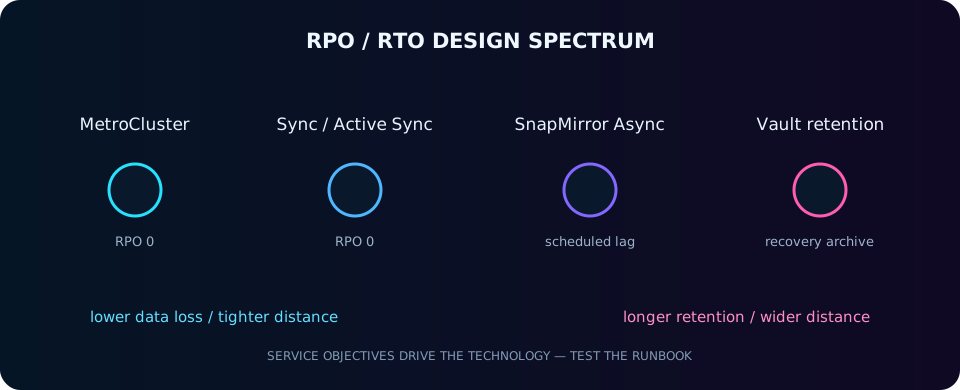
Define the decision space
RPO is the acceptable data-loss window; RTO is the acceptable recovery-time window. Add distance and latency, budget, data change rate, bandwidth, application consistency, dependency order, cyber-recovery needs, and the staffing available at 03:00. “Zero RPO” describes committed replicated writes; it does not mean every application dependency is instantly usable.
One comparison, different jobs
| Technology | Mechanism | RPO | RTO | Distance | Failover | Failback effort | Best fit |
|---|---|---|---|---|---|---|---|
| MetroCluster FC/IP | Synchronous mirrored aggregates plus stretched cluster | 0 for protected writes | Low; design-dependent | Campus/two-site; platform and latency limits apply | Planned switchover; automatic unplanned switchover in supported Mediator designs | Heal, switchback, validate | Site resilience with storage identity continuity |
| SnapMirror Sync | Synchronous volume replication over IP | 0 in sync | Manual activation | Network-latency constrained; cross-region only when limits are met | Manual break/host orchestration | Resync/reverse path | Zero data loss where automated active access is unnecessary |
| SnapMirror Async | Snapshot-based scheduled replication | Schedule plus transfer lag; often 15 minutes or more | Minutes to hours | IP/WAN, broadly flexible | Manual or externally orchestrated | Reverse resync and planned cutback | Cost-effective regional DR |
| SVM DR | Replicates an SVM namespace, volumes and supported configuration | Schedule/lag | Runbook-dependent | Intercluster IP | Manual/orchestrated activation | Reverse relationship and identity checks | Whole-SVM recovery |
| SnapMirror Active Sync / SM-BC | Synchronous consistency-group replication with host multipathing and Mediator | 0 when in sync | Near-zero/zero storage interruption in supported topology | Metro/latency constrained | Automated storage failover for supported failures | Resync and preferred-site restoration | Tier-1 active-active SAN; NAS support depends on release |
| SnapVault policy | SnapMirror vault policy retains destination snapshots | Backup schedule | Restore-dependent | Local or remote IP | None | Restore/reprotect | Long retention and archive |
| SnapCenter backups | Application plug-ins coordinate consistent snapshots and secondary copies | Policy schedule | Application restore-dependent | Follows storage targets | Application workflow, not site failover | Restore/reprotect | Oracle, SQL, VMware and other app-consistent recovery |
Exact RPO/RTO, distance, protocol, and automation support depend on ONTAP, platform, Mediator, application, and topology. Check the current Interoperability Matrix and product limits.
Which one when?
- Downtime budget: if seconds are unacceptable, evaluate MetroCluster or active sync; otherwise start with SVM/volume DR.
- Distance: if synchronous latency limits cannot be met, use asynchronous replication.
- Data-loss tolerance: zero pushes toward synchronous; minutes permit async; long-term recovery needs vault retention too.
- Automation: decide whether storage, hosts, networks, DNS, databases, and people can all fail over safely. Storage automation alone is not an application runbook.
Layer protection
A MetroCluster can protect the primary service from a site outage while asynchronous SnapMirror sends another copy to a distant failure domain. Add app-consistent SnapCenter retention and an immutable or isolated backup tier for cyber recovery. Each layer should address a different failure; duplicating the same administrative and network boundary is not independence.
cluster::> snapmirror show -fields relationship-type,policy,state,status,lag-time,last-transfer-end-timestamp
source-path destination-path type policy state status lag-time last-transfer-end-timestamp
prod:db     dr:db_dp         XDP  MirrorAndVault Snapmirrored Idle 00:16:42 8/27/2026 14:00:11
Test without improvising on production
A normal SVM DR initialization uses -vserver-dr-protection when creating the destination SVM; the flag is not an option to snapmirror initialize. Keep the DR relationship intact and rehearse through a supported isolated clone or designated test destination. Network test LIFs, DNS, credentials, routing, application startup order, and cleanup must be scripted.
dr::> vserver create -vserver finance_dr -subtype dp-destination -vserver-dr-protection protected
dr::> snapmirror create -source-path prod:finance -destination-path dr:finance_dr: -type XDP -policy MirrorAllSnapshots
dr::> snapmirror initialize -destination-path dr:finance_dr:
Operation is queued: snapmirror initialize of destination "dr:finance_dr:".
# Clone-based rehearsal from a replicated recovery snapshot
dr::> volume clone create -vserver test_svm -flexclone finance_test -type RW -parent-vserver dr_svm -parent-volume finance_dp -parent-snapshot nightly.2026-08-27_0000
[Job 9912] Job succeeded: SuccessfulFailover and failback sketches
Async / SVM DR
Confirm scope → stop/quiesce source if reachable → update final delta → quiesce → break → activate LIFs/hosts/apps → validate. For failback, stop apps, replicate the delta back with resync/reverse resync, activate original, and reprotect.
SnapMirror Sync
Confirm relationship state and write policy → coordinate hosts → break destination → bring services online. Re-establish synchronization only after declaring the authoritative copy.
MetroCluster
Use metrocluster operation show, validate, switchover, heal aggregates/root, then switchback when the failed site is healthy. Follow the model-specific procedure.
Active Sync
Verify consistency-group and Mediator health plus host paths. Planned failover is preferred; after an outage, confirm the surviving copy and resynchronize before restoring preferred-site placement.
dr::> snapmirror quiesce -destination-path dr:db_dp
dr::> snapmirror break -destination-path dr:db_dp
Operation succeeded: snapmirror break for destination "dr:db_dp".
siteA::> metrocluster check run
siteA::> metrocluster check show
Component Result
nodes ok
config-replication ok
aggregates okMonitor health and common failures
| Signal | Likely cause | Response |
|---|---|---|
| Lag grows every interval | Change rate exceeds bandwidth, transfer errors, or schedule overlap | Inspect transfer errors, network and baseline sizing; do not merely shorten schedule. |
| Expected recovery point missing | Source snapshot policy/labels do not match vault rules | Compare policy rules and snapshot labels. |
| Relationship broken after DR | Break was activation, not reprotection | Choose authoritative side, resync carefully, then restore monitoring. |
| “Healthy” storage, failed app | DNS, identity, host paths, certificates, or startup order omitted | Expand the test to the complete service. |
cluster::> snapmirror show -destination-path dr:db_dp -instance
Relationship Status: Idle
Relationship State: Snapmirrored
Lag Time: 00:16:42
Last Transfer Error: -
cluster::> snapmirror show -fields state,status,lag-time,last-transfer-end-timestamp