Home / Reference / NetApp vs Pure
NetApp ONTAP vs Pure Storage: two philosophies of enterprise storage
If you have to pick the storage platform for the next three years, the NetApp-vs-Pure decision is really a decision about what you believe storage is for. NetApp ONTAP is a unified storage operating system: one cluster that serves file, block, and object to everything, with the same OS running on-prem and in every major cloud. Pure Storage (branded Everpure since 2025) is a flash-first, block-centric platform built around a single design goal — the lowest-latency, simplest-to-operate all-flash array — now expanding into file, object, Kubernetes, and as-a-service. This guide compares them honestly: architecture, hardware, data reduction, protocols, DR, ransomware, automation, cloud strategy, and — most usefully — how to choose.
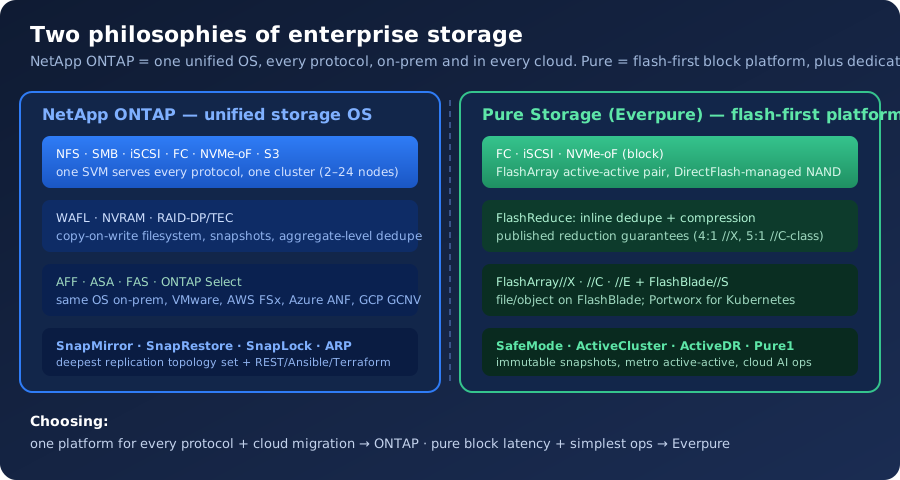
At a glance
| Dimension | NetApp ONTAP | Pure Storage (Everpure) |
|---|---|---|
| Core architecture | WAFL log-structured filesystem on RAID groups (RAID-DP/TEC), NVRAM write staging, cluster of 2–24 nodes | Purity OS with DirectFlash module (DFM) flash management, dual active-active controllers per array, no RAID in the traditional sense |
| Primary protocols | NFS, SMB/CIFS, iSCSI, FC/FCoE, NVMe-oF, S3 object — all on one system | FC, iSCSI, NVMe-oF (block-first); file/object via FlashBlade and FlashArray NAS features |
| Hardware families | AFF A-Series (all-flash), AFF C-Series (QLC), ASA (SAN-optimized), FAS (hybrid), ONTAP Select/One (software) | FlashArray//X (NVMe), //C (QLC capacity), //E (capacity-optimized), FlashBlade//S (file+object), FlashStack (Cisco converged) |
| Data reduction | Inline deduplication, compression, compaction, aggregate-level (cross-volume) dedupe; per-volume savings reporting | FlashReduce: always-on inline dedupe + compression with published guarantees (historically 4:1 on //X, 5:1 on //C-class systems) |
| Snapshots | Copy-on-write Snapshot copies (hundreds per volume), SnapRestore, SnapMirror (async/sync/SVM-DR), SnapVault | Purity snapshots, ActiveDR (async), ActiveCluster (synchronous stretch), SafeMode snapshots (immutable ransomware recovery) |
| Cloud & hybrid | Same ONTAP OS in AWS (FSx for ONTAP), Azure (ANF), GCP (GCNV), BlueXP/NetApp Console, Cloud Volumes ONTAP | Everpure cloud: Portworx (Kubernetes), Cloud Block Store (AWS/Azure), FlashBlade on cloud, Evergreen//One as-a-service |
| Management | CLI + REST API (OpenAPI), System Manager GUI, BlueXP/NetApp Console, Ansible/Terraform modules | Pure1 cloud management/AI ops, REST API, CLI, Terraform provider |
| Consumption model | Traditional purchase or Keystone (Flexible Consumption / storage-as-a-service) | Evergreen//Forever (buy once, upgrade controllers) or Evergreen//One (as-a-service with SLAs) |
Two different philosophies
Both vendors sell all-flash arrays with excellent data reduction and ransomware features. The architectural philosophy is where they genuinely diverge.
ONTAP is a storage OS that happens to run on hardware. The filesystem (WAFL) is a log-structured, copy-on-write design: writes are staged in NVRAM, laid down sequentially, and protected by RAID-DP (double-parity) or RAID-TEC (triple) at the aggregate level. Because the aggregate is a shared pool across many volumes, capacity, deduplication, and SnapMirror operate at the cluster scale. The same software image runs on an AFF A90, on a two-node FAS hybrid, as ONTAP Select on VMware, and as Amazon FSx for NetApp ONTAP or Azure NetApp Files. For a shop that lives in multiple worlds — VMware NFS, Windows SMB, Linux NFS, a SAN island, a little object storage — one cluster can serve all of it, and the skill set transfers to the cloud.
Purity is an operating system built around flash. Pure's signature move is the DirectFlash Module: raw NAND managed by the array's own software rather than by vendor SSDs' internal FTLs. Purity handles wear leveling and garbage collection itself, which is why Pure can ship modules without the usual SSD-overprovisioning overhead. The FlashArray is a two-controller active-active design — deliberately simple: no shelves of drives to manage in the traditional sense, and a management model that famously fits on "the back of a business card." The trade-off is scope: the classic FlashArray is block-first (FC/iSCSI/NVMe-oF), and file/object workloads live on FlashBlade or newer FlashArray NAS features rather than in one converged system.
Neither is "better" in the abstract. ONTAP optimizes for breadth and unification; Purity optimizes for block latency and operational simplicity. Everything below follows from that.
Hardware lineups compared
| Workload tier | NetApp | Pure Storage |
|---|---|---|
| Performance all-flash | AFF A-Series (e.g., A20–A90) — NVMe drives, up to 24 nodes per cluster | FlashArray//X (e.g., //X20–//X90 R4) — NVMe DirectFlash |
| Capacity-optimized flash | AFF C-Series (QLC) and FAS hybrid models | FlashArray//C (QLC, reduction guarantee) and //E (capacity-focused) |
| SAN-optimized | ASA (SAN-optimized ONTAP: block-only, no extra protocols, higher effective density) | FlashArray//X in SAN-only configs (FC/iSCSI/NVMe-oF) |
| File + object | Any ONTAP node (NFS/SMB/S3 in the same system) | FlashBlade//S (scale-out file + object), FlashArray NAS features |
| AI / converged | AIPod (with NVIDIA), FlexPod (with Cisco UCS), ONTAP AI reference architectures | FlashStack (with Cisco), Pure AI reference architectures with NVIDIA |
| Software-defined | ONTAP Select (VMware/KVM), ONTAP One licensing, Cloud Volumes ONTAP | Purity on FlashStack converged; no general-purpose virtual appliance equivalent |
Model numbers and drive options change every refresh cycle; check the current datasheets before sizing. The structural difference to remember: NetApp's cluster scales out (multiple HA pairs as one namespace, up to 24 nodes) and sells a true hybrid (FAS) and software-defined tier; Pure sells tightly-integrated pairs and a separate scale-out file/object platform. NetApp's ASA family is the direct answer to "we only need block" — it strips ONTAP down to SAN-only, which narrows the feature-vs-simplicity gap considerably.
Data reduction: how the savings math works
Both vendors do inline deduplication and compression; neither has a meaningful advantage on the headline algorithm. The differences are in where savings happen and how they're guaranteed.
- ONTAP: inline dedupe + compression + compaction per volume, plus aggregate-level deduplication across volumes, and FlexClone's zero-copy clones. Savings policies are per-volume (
volume efficiency), and you can see exactly what each volume saves withdf -h(thesaved%columns) orvolume efficiency show. Space is reclaimed when the dedupe job runs (or immediately for inline). Because the aggregate is shared, ONTAP's dedupe also works across volumes in the same aggregate — useful for VM farms with similar OS images. - Pure: FlashReduce runs dedupe + compression inline and always-on, with published reduction guarantees (historically 4:1 on //X systems and 5:1 on //C-class) — if an array doesn't hit the guarantee, Pure makes up the difference with free capacity. That guarantee is a sales differentiator and a real planning tool. Pure1 reports post-reduction capacity continuously.
Real-world reduction depends far more on workload than vendor: databases with random 8K writes compress poorly; VDI golden images dedupe spectacularly. Treat any vendor's average as marketing and measure on your own data — ONTAP's volume efficiency and Pure1 both let you run estimates before you buy.
# ONTAP: see per-volume savings across the cluster
df -h -aggregate aggr1                          # saved% column per volume
volume efficiency show -vserver vs1             # dedupe/compression job state
volume efficiency start -vserver vs1 -volume vol1   # run dedupe now
volume show -fields volume,size,used,available,percentage-saved
Protocols and workload coverage
This is the biggest practical difference for most buyers.
- One system, every protocol (ONTAP): a single SVM can export NFSv3/v4/v4.1, serve SMB 3.x, present iSCSI/FC LUNs, and host S3 buckets simultaneously — even to the same data via multiprotocol access with identity mapping (Unix, NTFS, or mixed security styles). One cluster can therefore replace separate NAS and SAN silos, and
vserver add-protocolscan add a protocol family to an existing SVM without new hardware. - Block-first with dedicated file/object (Pure): the FlashArray speaks FC, iSCSI, and NVMe-oF natively — historically its strongest, simplest story. File (NFS/SMB) and object (S3) come from FlashBlade (scale-out) or FlashArray NAS features in newer Purity releases. If your environment is 90% VMware/SQL/Oracle on block, that's a non-issue; if you need one box for NFS home directories and Oracle ASM and an S3 landing zone, ONTAP's unified SVM model is structurally simpler.
For NVMe over Fabrics specifically, both support NVMe-oF (TCP and FC) — modern all-flash buyers rarely care about iSCSI/FC beyond legacy compatibility, and both cover that too.
Snapshots, replication, and DR
| Capability | NetApp ONTAP | Pure Storage |
|---|---|---|
| Local snapshots | Copy-on-write Snapshot copies; hundreds per volume; snapmirror/volume snapshot CLI; SnapRestore for instant rollback | Purity snapshots (space-efficient, per-volume); instant restore from Pure1 or CLI |
| Async replication | SnapMirror: volume, SVM (vserver), and FlexGroup replication; throttling, fan-out, cascade topologies; snapmirror show for status | ActiveDR: continuous async replication with near-zero RPO, simple failover/failback |
| Sync / metro replication | SnapMirror Synchronous (SM-S), MetroCluster (stretch HA with synchronous mirroring + automatic failover) | ActiveCluster: active-active synchronous replication across two arrays, transparent failover to hosts |
| Backup integration | SnapVault/NetApp SnapCenter, Commvault IntelliSnap, Veeam with NetApp integration (array-integrated backup) | Snapshots via Pure Storage Protect (formerly Pure1 Protect assessment), Commvault/Veeam integration |
| Ransomware recovery | ARP (anti-ransomware), FPolicy, SnapLock immutability, NAE/NVE encryption, Snapshot-based restore | SafeMode snapshots (immutable, time-locked, require two-factor to delete) — a genuinely strong story |
ONTAP's DR topology options are the deepest in the industry (SnapMirror cascade/fan-out, SVM-DR for a whole vserver, MetroCluster for zero-RPO stretch). Pure's ActiveCluster gives block workloads an exceptionally clean active-active model, and SafeMode is one of the best-known ransomware-recovery mechanisms in the market. For pure-block DR, Pure is at parity or better; for heterogeneous, multi-site, multi-protocol DR, ONTAP's SnapMirror ecosystem is hard to beat.
Security and ransomware
Both vendors now treat ransomware as a first-class concern, and both use the same fundamental defense: immutable, instant-recovery snapshots outside the reach of the attacker.
- ONTAP: SnapLock (Compliance/Enterprise) makes volumes immutable for a set retention period — including against administrators, which is what makes it compliance-relevant. ARP uses machine learning to detect ransomware-style activity and auto-creates Snapshot copies when it suspects an attack. FPolicy can block suspicious file extensions/patterns in real time. NVE/NAE encrypt data at rest, and ONTAP 9.14+ tightened the snapshot-deletion path (SnapLock "apply retention to existing snapshots", restricted delete). See the security hardening checklist.
- Pure: SafeMode snapshots are the flagship: snapshots that cannot be deleted before their retention expiry, protected by a separate multi-factor-authenticated process, so even a compromised admin account can't scrub the recovery points. ActiveDR/ActiveCluster add an offsite copy dimension.
Both are legitimate answers to "how do we recover when ransomware hits?" — the difference is operational: ONTAP gives you policy control via CLI/REST (scriptable, granular), Pure gives you a famously simple switch that just works.
Management, APIs, and automation
ONTAP's automation story is its quiet superpower: the ONTAP REST API (OpenAPI 3.0) covers virtually everything the CLI does, with first-class Ansible and Terraform modules, and the CLI itself is fully scriptable. Everything in this guide's commands has a REST equivalent. See the REST API guide for curl/Ansible/PowerShell examples.
Pure's Pure1 is a genuinely excellent cloud management plane — AI-driven capacity/health prediction ("Pure1 Meta" analytics), fleet-wide visibility, and simple upgrade orchestration. Pure's REST API and Terraform provider cover array provisioning well. If your org standardizes on Terraform/Ansible, both work; if your team lives in the CLI, ONTAP's is dramatically richer (thousands of commands, event/EMS management, event generate for testing, etc.).
# ONTAP: everything is scriptable — e.g., snapshot + replicate in two lines
volume snapshot create -vserver vs1 -volume vol1 -snapshot dr-$(date +%F)
snapmirror update -destination-path vs2:vol1

# REST equivalent (curl, one-liner pattern)
curl -s -u admin:pass -H "Content-Type: application/json" \
  -X POST "https://cluster/api/storage/volumes/vol1/snapshots" \
  -d '{"name":"dr-2026-08-24"}'
Cloud and hybrid strategy
This is where the two companies' strategies most visibly differ — and where NetApp's "ONTAP everywhere" bet pays off for hybrid shops.
- NetApp: the same ONTAP OS is available as Amazon FSx for NetApp ONTAP, Azure NetApp Files, Google Cloud NetApp Volumes, Cloud Volumes ONTAP (self-managed on any hyperscaler), and via BlueXP / NetApp Console as the control plane. A volume replicated from on-prem to FSx via SnapMirror uses the identical snapshot and cloning semantics — no re-platforming of scripts, no retraining. The FSx, ANF, GCNV, and BlueXP guides cover each.
- Pure (Everpure): the cloud story is Portworx (container-native storage for Kubernetes on any cloud), Cloud Block Store (block storage on AWS/Azure backed by commodity cloud disks), FlashBlade for file/object in some clouds, and Evergreen//One as-a-service with data mobility. It's a strong Kubernetes story but not an "identical array OS everywhere" story — the on-prem FlashArray and the cloud service are different products.
If the plan is "lift and shift to AWS but keep enterprise storage features," FSx for ONTAP gives you the same commands, snapshots, and replication in the cloud. If the plan is "Kubernetes-native storage everywhere," Portworx is arguably the strongest of the two options.
Consumption and lifecycle models
- NetApp Keystone: flexible consumption (pay-per-use) across on-prem and cloud, with NetApp operating the array; includes FlexPod and cloud options. Traditional CapEx purchase remains standard.
- Pure Evergreen//Forever: the famous "buy once, upgrade forever" model — controllers swap without forklift upgrades and without repurchasing capacity; Evergreen//One is the fully-managed as-a-service tier with published SLAs.
Pure's Evergreen program changed how the industry thinks about refresh cycles, and it remains a genuine differentiator for finance teams that hate forklift upgrades. Keystone is NetApp's equivalent answer but is positioned more as a consumption/financing model than a hardware-lifetime guarantee.
Migrating between the two
There is no native replication between ONTAP and Purity — snapshots and replication are vendor-specific. Realistic migration paths:
- Block (LUNs): present both sides to the hosts and use host-based copy —
dd, Storage vMotion with an intermediate datastore, SQL/Oracle native backup/restore, or a storage-agnostic migration tool. For VMware, Storage vMotion between the two arrays is the cleanest path (no downtime, no vendor lock-in). - File (NFS/SMB): rsync/robocopy for the final copy, or NetApp XCP (if migrating to ONTAP) / Pure's file migration tooling (if migrating to FlashBlade). Plan for a final cutover pass, then retire the source.
- Ongoing DR during migration: keep the old array's replication running until the last cutover, then fail over once.
ONTAP-side prep commands for the migration window:
# ONTAP: verify space and snapshot policy before/after cutover
volume show -vserver vs1 -fields volume,size,used,available
volume snapshot show -vserver vs1 -volume vol1        # recovery points on the source
volume efficiency start -vserver vs1 -volume vol1     # reclaim before final copy
Decision guide: which one, and when
| Your situation | Lean toward | Why |
|---|---|---|
| Mixed NFS + SMB + block + object, one team, one budget | NetApp ONTAP | Unified SVM model serves everything from one cluster; one skill set, one support contract. |
| Cloud migration is on the roadmap (AWS/Azure/GCP) | NetApp ONTAP | FSx/ANF/GCNV run the same OS; SnapMirror bridges on-prem and cloud. |
| Pure block latency for database workloads | Pure (Everpure) | DirectFlash + simple active-active design is hard to beat for latency-sensitive block. |
| Team wants "it just works" operations, no deep storage expertise | Pure (Everpure) | Pure1 simplicity and Evergreen lifecycle remove most day-2 operational surface. |
| Kubernetes-first, containers everywhere | Pure (Everpure) | Portworx is a mature container-native storage layer. |
| Heavy automation via CLI/API, custom tooling | NetApp ONTAP | Deepest CLI/REST/Ansible/Terraform coverage in the industry. |
| Strict ransomware/compliance regime | Either | SnapLock vs SafeMode both qualify; pick based on the rest of the stack. |
| NCDA/ONTAP skills investment | NetApp ONTAP | Certification ecosystem, community knowledge, and job market for ONTAP skills. |
The honest summary: choose NetApp when you need one platform for many protocols and many locations (including clouds); choose Pure when block performance and operational simplicity are the dominant requirements. Both are excellent, both have strong ransomware and data-reduction stories — the decision is about the breadth of your environment, not a spec-sheet victory.
Related reading
- SVM administration guide — the unified multi-protocol model in practice
- ONTAP security hardening checklist — SnapLock, ARP, FPolicy, encryption
- FSx for ONTAP guide and Azure NetApp Files — ONTAP in the cloud
- How ONTAP actually works: WAFL — the filesystem under the comparison
- ONTAP REST API automation — scriptable everything
Verification note: Pure model numbers, reduction guarantees, and specific Purity features change frequently; the structural comparison (unified OS vs flash-first block platform) is stable, but confirm current lineups on the vendors' datasheets before sizing. NetApp commands above are real ONTAP 9.x CLI.