Home / Reference / NetApp vs Dell PowerStore
NetApp ONTAP vs Dell PowerStore: two philosophies of enterprise storage
NetApp ONTAP and Dell PowerStore represent two leading approaches to enterprise all-flash and hybrid storage. This architectural and operational comparison covers core filesystem mechanics, NVMe performance, data reduction guarantees, multi-protocol NAS vs block specialization, replication topologies, and first-party cloud tiering.
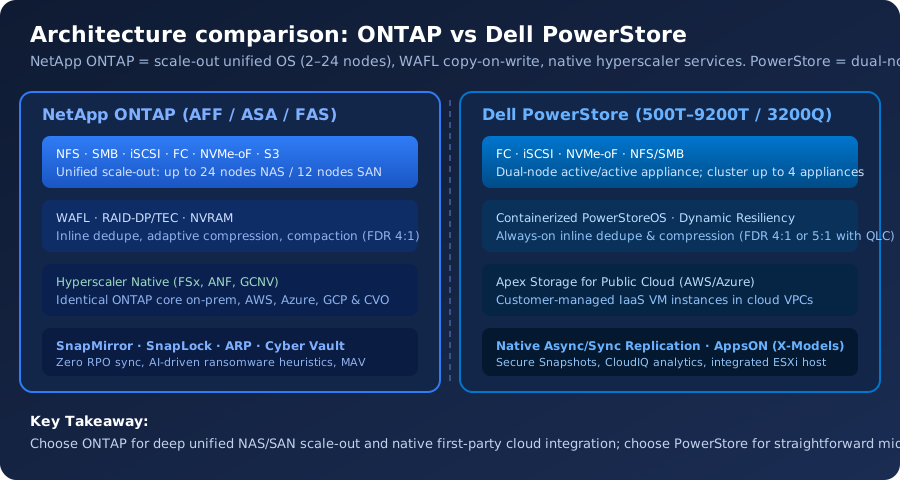
At a glance
| NetApp ONTAP | Dell PowerStore | |
|---|---|---|
| Architecture | WAFL write-anywhere file layout on aggregate/SVM model; one OS spans NAS + SAN + object tiers | NVMe-native unified appliance (block + file + vVols); dual-node active-active per appliance, scale-out clustering |
| Hardware lines | AFF A-Series (all-flash FAS), ASA R2 (SAN-only), FAS hybrid | PowerStore T (unified) and X (apps-on-array) appliances, 1200–9200 class scale-up/scale-out |
| Data reduction | Inline dedupe/compression/compaction, post-process options, temperature-aware storage efficiency | Always-on inline dedupe/compression with a 4:1 data-reduction guarantee |
| Protocols | NFS, SMB, iSCSI, FC, FCoE, NVMe/TCP, NVMe/FC, S3 (FabricPool) | iSCSI, FC, NVMe/FC, NVMe/TCP, SMB, NFS, FTP/SFTP, vVols |
| Replication/DR | SnapMirror (async/sync), SVM-DR, MetroCluster (stretched fabric) | Built-in async + synchronous replication between appliances; snapshot-based DR |
| Cloud presence | Same OS in AWS/Azure/GCP (FSx, ANF, GCNV) + Cloud Volumes ONTAP | No first-party cloud array service; APEX block storage services in public cloud are a separate platform |
| Management | ONTAP CLI + REST API, Active IQ, BlueXP/NetApp Console | PowerStore Manager UI + REST API, Dell AIOps/CloudIQ telemetry, PSTCLI |
| Lifecycle model | Keystone consumption service; traditional purchase | "Future-proof" program: controller upgrades and data-in-place migration across generations |
The short version: ONTAP is a software-defined, protocol-unified operating system that runs on NetApp hardware and in every major cloud, while PowerStore is a tightly engineered NVMe appliance whose appeal is simplicity, density, and an aggressive always-on efficiency guarantee. They overlap most in mid-size all-flash block estates; they diverge at the edges — multi-protocol NAS scale, cloud consistency, and deep CLI automation favor ONTAP, while appliance simplicity and NVMe-first design play to PowerStore.
Architecture: WAFL everywhere vs NVMe-native appliance
- ONTAP: WAFL is a write-anywhere filesystem that underpins everything — every volume, qtree, LUN, and Snapshot copy lives in the same logical structure, which is why Snapshot, FlexClone, and SnapMirror semantics are identical for NAS and SAN. Clusters scale out with SVMs isolating tenants/protocols; see the WAFL guide and SVM guide.
- PowerStore: designed from scratch around NVMe with an end-to-end dual-active architecture — each appliance is an active-active node pair, and appliances cluster (scale out) behind a single management plane. File, block, and vVols run natively on the same appliance, and built-in machine-learning analytics steer placement and health ("self-driving" operations). There is no equivalent of ONTAP's aggregate or SVM tenant model — resources are managed per appliance/cluster.
Practical consequence: ONTAP rewards teams that centralize many workloads and protocols on one cluster with policy-driven QoS and multi-tenancy; PowerStore rewards teams that want predictable, appliance-grade performance without building cluster topology at all.
Hardware lineups
| Tier | NetApp | Dell |
|---|---|---|
| Entry all-flash | AFF A-Series lower models / FAS50-class hybrid | PowerStore 1200–3200 (T models) |
| Mid-range | AFF A250/A400-class, ASA R2 systems | PowerStore 4200–5200 |
| High-end | AFF A700s/AFF A90-class, MetroCluster configs | PowerStore 7200–9200, multi-appliance clusters |
| Special purpose | StorageGRID (object), E-Series (SAN-only value) | PowerFlex (software-defined), PowerScale (file), PowerProtect (backup) |
Dell's answer to "one vendor, many workloads" is the portfolio: PowerStore sits beside PowerScale (file), PowerFlex (SDS), and PowerProtect rather than replacing them. NetApp's bet is the opposite — ONTAP itself stretches across those use cases, with StorageGRID covering object. If your shop wants a single storage OS to learn, that difference matters more than any spec sheet.
Efficiency and performance
- ONTAP: inline and post-process dedupe/compression/compaction per volume,
volume efficiencytooling, FabricPool tiering to S3-capable targets for cold data. Efficiency is tunable and scriptable; see the storage efficiency guide. - PowerStore: always-on inline dedupe and compression for all LUNs/volumes with a 4:1 guarantee, plus thin provisioning by default — there is essentially nothing to tune, which some teams will love and capacity planners will find opaque.
For latency-sensitive block workloads both are excellent; PowerStore's NVMe-native design (NVMe/FC and NVMe/TCP front-end) is competitive with AFF on modern fabrics. Where ONTAP pulls ahead is mixed NAS+SAN estates: one cluster serving SMB file shares, VMware datastores, and database LUNs with a single snapshot/replication policy framework.
Replication and DR
| Capability | NetApp | Dell PowerStore |
|---|---|---|
| Async replication | SnapMirror (RPO down to minutes, cascade/fan-out topologies) | Asynchronous replication between appliances |
| Sync/near-sync | Sync SnapMirror; MetroCluster for zero-data-loss stretch | Synchronous replication (short-distance, latency-bound) |
| Whole-tenant failover | SVM-DR replicates an entire vserver including config | Per-resource (volume/LUN/file system) protection policies |
| Backup integration | SnapVault/SnapCenter, Veeam/Commvault array integration | Snapshots via protection policies; Veeam/Commvault integration |
| Ransomware recovery | ARP, FPolicy, SnapLock immutability, NAE/NVE encryption — see the ransomware guide | Secure Snapshots (immutable, role-separated deletion) — a credible comparable story |
ONTAP's DR topology catalog (SnapMirror fan-out, SVM-DR, MetroCluster) remains the deepest option set in the industry, especially for multi-site and multi-protocol estates. PowerStore covers the standard "replicate to a second appliance" case cleanly with less to configure.
Security and ransomware
Both vendors converge on immutable snapshots as the core anti-ransomware control:
- ONTAP: SnapLock Compliance/Enterprise volumes are immutable against even administrators for the retention period; ARP auto-creates snapshots when it detects attack-like behavior; FPolicy can block suspicious writes in real time; NVE/NAE encrypt at rest. See the hardening checklist.
- PowerStore: Secure Snapshots cannot be deleted during their retention window, with separation of duties around the deletion path, plus built-in encryption at rest.
The difference is operational surface: ONTAP exposes every control via CLI/REST so you can audit and automate it; PowerStore-style simplicity on the Dell side means fewer knobs but also less granular scripting.
Management, APIs, and automation
ONTAP's automation story is its quiet superpower: the ONTAP REST API (OpenAPI 3.0) covers virtually everything the CLI does, with first-class Ansible and Terraform modules. Everything in this site's guides maps to REST equivalents — see the REST API guide.
PowerStore is managed through PowerStore Manager (browser UI) and a clean REST API, with PSTCLI for command-line users and Dell AIOps/CloudIQ providing fleet telemetry similar to Active IQ. Day-to-day it is genuinely simple; what it lacks is ONTAP's breadth — thousands of CLI commands for events, EMS, QoS, and diagnostics that power users lean on. Example from the ONTAP side:
# ONTAP: snapshot + replicate in two scriptable lines
volume snapshot create -vserver vs1 -volume vol1 -snapshot dr-$(date +%F)
snapmirror update -destination-path vs2:vol1

# REST equivalent (curl, one-liner pattern)
curl -s -u admin:pass -H "Content-Type: application/json" \
  -X POST "https://cluster/api/storage/volumes/vol1/snapshots" \
  -d '{"name":"dr-2026-08-26"}'
Cloud and hybrid strategy
- NetApp: the same ONTAP OS runs as Amazon FSx for NetApp ONTAP, Azure NetApp Files, Google Cloud NetApp Volumes, and Cloud Volumes ONTAP, controlled via BlueXP / NetApp Console. SnapMirror bridges on-prem and cloud with identical semantics — see the FSx, ANF, GCNV, and BlueXP guides.
- Dell: no first-party cloud instance of PowerStore itself. Dell's cloud story runs through APEX Block Storage for AWS/Azure and the broader APEX portfolio — capable, but the on-prem appliance and the cloud service are different platforms, not the same OS in two places.
If "lift to cloud but keep enterprise storage features and scripts" is the goal, ONTAP's same-OS-everywhere model is the stronger fit; if the estate stays on-premises, this axis matters little.
Consumption and lifecycle models
- NetApp Keystone: pay-per-use consumption across on-prem and cloud, alongside traditional CapEx purchase.
- Dell PowerStore "future-proof" guarantees: published data-reduction guarantee, controller upgrade path within a generation, and data-in-place controller migrations — no forklift re-ingest when swapping heads.
Dell's lifecycle guarantees are among the strongest in the industry and directly target the finance objection to refresh cycles. Keystone is positioned as flexible consumption rather than a lifetime hardware promise — compare contract terms, not slogans.
Migrating between the two
There is no native replication between ONTAP and PowerStore — snapshots and replication are vendor-specific. Realistic migration paths:
- Block (LUNs): present both arrays to the hosts and migrate with Storage vMotion,
dd, or native database backup/restore; Storage vMotion is the cleanest VMware path. - File (NFS/SMB): rsync/robocopy for the final pass, or NetApp XCP when migrating to ONTAP.
- Cutover window: keep the source array's replication running until final cutover, then fail over once.
ONTAP-side prep commands for the migration window:
# ONTAP: verify space and snapshots before/after cutover
volume show -vserver vs1 -fields volume,size,used,available
volume snapshot show -vserver vs1 -volume vol1        # recovery points
volume efficiency start -vserver vs1 -volume vol1     # reclaim before final copy
Decision guide: which one, and when
| Your situation | Lean toward | Why |
|---|---|---|
| Mixed NFS + SMB + block, one team, one budget | NetApp ONTAP | Unified SVM model serves everything from one cluster with one policy framework. |
| Cloud migration on the roadmap (AWS/Azure/GCP) | NetApp ONTAP | FSx/ANF/GCNV run the same OS; SnapMirror bridges on-prem and cloud. |
| Predictable all-flash block appliance, minimal tuning | Dell PowerStore | NVMe-native design, always-on efficiency, low day-2 operational surface. |
| Finance requires no-forklift lifecycle guarantees | Dell PowerStore | Data-in-place controller upgrades and reduction guarantees are contractual. |
| Multi-site DR with cascaded/fan-out replication | NetApp ONTAP | SnapMirror topologies, SVM-DR, MetroCluster have no PowerStore equivalent. |
| Deep CLI/API automation and custom tooling | NetApp ONTAP | Deepest CLI/REST/Ansible/Terraform coverage in the industry. |
| Strict ransomware/compliance regime | Either | SnapLock vs Secure Snapshots both qualify; decide on the rest of the stack. |
| NCDA/ONTAP skills investment | NetApp ONTAP | Certification ecosystem, community knowledge, and job market for ONTAP skills. |
The honest summary: choose NetApp when you need one platform for many protocols and many locations (including clouds); choose PowerStore when a tightly engineered, low-touch all-flash appliance is the actual requirement. Both are excellent at the core block/NAS job — the decision is about the breadth of your environment, not a spec-sheet victory.
Related reading
- NetApp ONTAP vs Pure Storage — the other major competitor comparison
- SVM administration guide — the unified multi-protocol model in practice
- ONTAP security hardening checklist — SnapLock, ARP, FPolicy, encryption
- How ONTAP actually works: WAFL — the filesystem under the comparison
- ONTAP REST API automation — scriptable everything
Verification note: Dell model numbers, guarantee terms, and specific PowerStore features change frequently; the structural comparison (one unified OS vs engineered NVMe appliance) is stable, but confirm current lineups and contract terms on Dell's datasheets before sizing. NetApp commands above are real ONTAP 9.x CLI.