NetApp ONTAP glossary
Every acronym, concept, and object you'll meet on an ONTAP system, in plain English. Type to filter; jump with the letter bar. Cross-referenced from the NCDA fundamentals page and the CLI cheat sheet.
A
- alias
- A second name for a feature object, such as a CIFS NetBIOS server name, tape device, or FC WWPN. ONTAP 9.19.1 does not document a general administrator command-alias facility; keep CLI shortcuts in the calling shell. See CLI scripting.
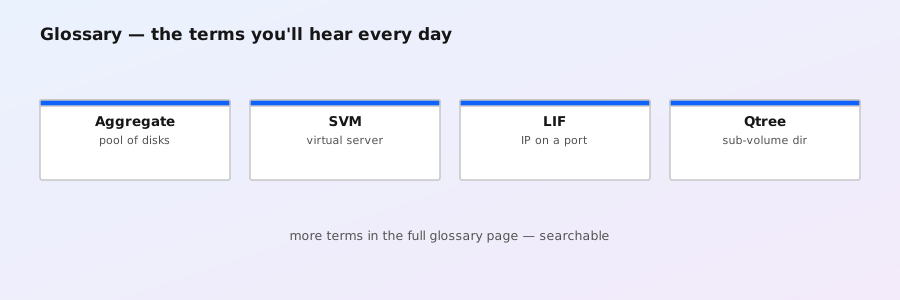
- aggregate
- The physical storage pool: one or more RAID groups of disks (or an all-flash pool) formatted as a single WAFL filesystem. Aggregates own the raw space; volumes are created inside them. See WAFL deep-dive.
- AFF
- All-Flash FAS — NetApp's all-NVMe/all-SSD platform line. Same ONTAP, no spinning disks, designed for low latency and high IOPS.
- AIPod
- NetApp's prevalidated AI infrastructure stack pairing NVIDIA accelerated compute (DGX-class) with NetApp AFF all-flash storage running ONTAP, designed to start small and scale without redesigning the data layer. AIPod Mini is the Intel Xeon/Gaudi variant for departmental and edge AI.
- ARP (Autonomous Ransomware Protection)
- ONTAP's on-box ransomware detection: it learns a volume's normal file-activity baseline, then watches for mass-encryption patterns and automatically creates a recovery snapshot when an attack is suspected. See the Autonomous Ransomware Protection & Cyber Vault guide and security hardening checklist.
- ASA
- AFF SAN Array — an AFF system locked into SAN-only mode (no NAS protocols, no SVMs in the usual sense). Simplifies FC/NVMe-over-FC deployments; storage is presented as LUNs only.
- AUSO
- Automatic Unplanned Switchover — the MetroCluster feature that lets the surviving site take over automatically after a site failure, with the mediator's vote.
- AutoSupport
- ONTAP's built-in health telemetry: periodic and event-triggered messages sent to NetApp (or your own mail server) so support can see the system's state before you open a case. See the AutoSupport, EMS & Active IQ guide.
- autodelete (Snapshot)
- An ONTAP volume policy that can delete eligible snapshots when configured space-pressure triggers are reached. Review the trigger, target, commitment and deletion order before enabling it; see common space mistakes.
- audit log
- Evidence of selected data-access or management activity. ONTAP writes SVM NAS audit records to rotated EVTX/XML files and keeps administrative requests in the cluster security audit log. See the audit & event logging guide.
- adaptive QoS
- A QoS mode where performance ceilings scale automatically with storage size, rather than being fixed numbers you set once.
- Azure NetApp Files (ANF)
- Microsoft's first-party managed file service in Azure. Capacity is provisioned as pools with service levels; volumes are managed through Azure APIs rather than an ONTAP cluster CLI. See the ANF guide and cloud decision guide.
- Astra Control
- NetApp's application-aware data management suite for Kubernetes (Astra Control Center on-prem, Astra Control Service in cloud). Orchestrates app-consistent backups, snapshot schedules, and cross-cluster disaster recovery powered by ONTAP and SnapMirror. See the Trident & Kubernetes guide.
- ALUA
- Asymmetric Logical Unit Access — the SCSI T10 multipath standard ONTAP uses for SAN LUNs in an HA pair: each host path is marked active-optimized (through the LUN's home node) or active-non-optimized (partner node via cluster interconnect). See the SAN & multipathing guide.
- ANA
- Asymmetric Namespace Access — the NVMe-oF multipathing specification (equivalent to SCSI ALUA) used in NVMe/FC and NVMe/TCP to report optimized, non-optimized, and inaccessible namespace path states to hosts.
- Active IQ
- NetApp's cloud digital advisor, which analyzes AutoSupport telemetry for risks, capacity trends, upgrade recommendations, and support insights.
- aggregate hot spot
- An aggregate whose disks or controller path are disproportionately busy, making it a bottleneck while capacity or performance remains available elsewhere.
- Ansible collection
- The
netapp.ontapautomation modules used to configure and operate ONTAP through REST or legacy ONTAPI. - auto-giveback
- An HA setting that returns aggregates to their home node automatically after recovery and safety checks. See the HA pairs guide.
- autosize
- A FlexVol policy that grows a volume, or grows and shrinks it, when used-space thresholds are crossed within configured minimum and maximum sizes. See the FlexVol guide.
- AutoSupport invoke
- A manually triggered AutoSupport message, commonly used to test delivery or send a user-defined support notification.
B
- broadcast domain
- The grouping of network ports that share L2 reachability and MTU; ONTAP uses it for LIF placement and failover. See network architecture.
- break (SnapMirror)
- Stopping replication so the destination can be written to independently — the first step of an unplanned failover. Re-establish with a resync afterwards.
- BlueXP
- NetApp's SaaS control plane (bluexp.netapp.com) for managing on-prem ONTAP clusters and cloud storage — Cloud Volumes ONTAP, FSx for ONTAP, Azure NetApp Files — from one dashboard. Free to use; you pay for the storage systems it manages. See the BlueXP guide.
- A node-console startup menu for maintenance and recovery operations such as booting an alternate image, initializing disks, or entering maintenance mode.
- bucket
- The top-level S3 object container exposed by ONTAP, with its own capacity and access policy. See the ONTAP S3 guide.
C
- CHAP
- Challenge-Handshake Authentication Protocol, used to authenticate an iSCSI initiator to an ONTAP target; mutual CHAP authenticates both directions. See the iSCSI guide.
- cluster
- The whole ONTAP system: two or more nodes (up to 24 in a cluster) that share management, SVMs, and a unified namespace.
- capacity pool (ANF)
- In Azure NetApp Files, the provisioned block of billed capacity with a fixed service level (Standard/Premium/Ultra) that determines per-TiB throughput. Volumes are carved out of a pool. See the ANF guide.
- Cloud Volumes ONTAP (CVO)
- ONTAP packaged as VMs that run in AWS, Azure, or GCP on standard compute. You operate it like on-prem ONTAP (full CLI, node shell) and typically deploy it via BlueXP. The middle ground between fully managed (FSx/ANF) and buying hardware. See the BlueXP guide.
- cluster peering
- A trust relationship between two ONTAP clusters that enables cross-cluster data movement: SnapMirror, SnapVault, SVM DR, and FlexCache. Uses Intercluster LIFs (IC-LIFs), full-mesh TCP/10000 communication, and TLS in-flight encryption. See the Cluster & SVM Peering guide.
- CIFS
- The older name for SMB file sharing, still used in ONTAP for SMB server objects (
vserver cifs). SMB 3.x is the modern protocol version. - SMB Multichannel
- SMB 3.x feature (enabled by default on ONTAP) where a client session uses multiple TCP connections — one per client/server NIC pair — to aggregate bandwidth and survive NIC failure. Verify with
vserver cifs session show -fields connection-count. - An SMB 3 share marked
continuously-availablethat survives ONTAP takeover/giveback via persistent handles — required for Hyper-V and SQL Server over SMB. Requires the CA license and a CA-aware client. - consistency point (CP)
- The moment WAFL atomically flips its root pointer, committing batched writes to disk. The filesystem is always consistent because states change only at CPs.
- consistency group (CG)
- A named group of volumes that ONTAP snapshots as one unit, so every member volume is captured at the same instant — how multi-volume applications (Oracle, SAP HANA, VMware datastores) avoid torn writes across members. Managed with
volume consistency-groupcommands, SnapCenter, or BlueXP. See the SnapCenter guide. - constituent
- One of the FlexVols that make up a FlexGroup. Files are distributed across constituents; each lives on its own aggregate.
- copy-on-write (CoW)
- WAFL's rule that changed blocks are written to new locations rather than overwritten in place — what makes snapshots and clones nearly free. See the deep-dive.
- cloud tiering (FabricPool)
- Moving cold blocks of a volume to object storage (S3, Azure Blob, Google Cloud, StorageGRID) while hot blocks stay on local flash. The volume still looks and behaves like one filesystem. See the FabricPool deep-dive.
- compression
- Storage efficiency: compressing data blocks to reduce physical footprint. ONTAP does inline (at write time) and post-process (background) compression.
- callhome
- A legacy operational term for an AutoSupport notification sent off-cluster when ONTAP detects a significant event.
- CBL (capacity-based licensing)
- A model that meters protected or managed capacity rather than licensing each controller or feature individually. See the licensing guide.
- capacity unit
- A metered quantity of storage used for subscription, service-level, or licensing calculations; its exact scope depends on the offering.
- CFE
- Common Firmware Environment — the low-level boot firmware and console environment used by many ONTAP hardware platforms.
- cluster management LIF
- The floating administrative IP used to manage the whole cluster; it can migrate between nodes independently of data LIFs.
- compaction
- A storage-efficiency technique that packs multiple small compressed data blocks into one 4 KiB physical block.
- ComplianceClock
- SnapLock's tamper-resistant time base for retention expiry; it cannot be moved backward. See the SnapLock guide.
- counter manager
- The ONTAP subsystem that organizes performance objects, instances, and counters consumed by
statisticscommands and monitoring tools. See performance counter concepts.
D
- dNFS (Oracle Direct NFS)
- Oracle's database-integrated NFS client, which can manage NFS paths and I/O independently of the host kernel client. Validate protocol and mount settings for the certified Oracle/ONTAP stack; see databases on ONTAP.
- DDP (Dynamic Disk Pools)
- SANtricity pool layout that distributes data, parity, and preservation capacity across the participating drives instead of using fixed RAID groups and dedicated spares. See the E-Series & EF-Series guide.
- deduplication
- Storage efficiency: replacing duplicate blocks with pointers to a single shared block. Most effective for virtual machine disks and copies of the same data.
- destination volume
- The replica side of a SnapMirror relationship — read-only during normal replication, writable once you break the relationship.
- disk ownership
- Which node in the HA pair owns a given disk. Disks can be moved between partners; ownership is what lets takeover/giveback work.
- data protection (DP)
- The volume type used for SnapMirror/SnapVault destinations. DP volumes exist only to hold replicas and aren't directly mounted.
- disaster recovery
- The set of processes and technologies (SnapMirror, MetroCluster, SVM DR) that keep data available after a site or system loss. See MetroCluster.
- disk shelf
- The physical enclosure holding disks, attached to nodes via SAS or NVMe cabling. Shelves provide power, cooling, and the disk-to-node connections.
- Disk Qualification Package (DQP)
- An ONTAP package containing supported-drive identification and qualification data, updated when newly qualified disks must be recognized.
E
- E-Series
- NetApp's SAN-focused block-storage family running SANtricity OS rather than ONTAP; EF-Series denotes flash-focused models. See the E-Series & EF-Series guide.
- EMS
- Event Management System — ONTAP's on-cluster event stream, with severity filtering and destinations such as syslog, SNMP, and email. See the AutoSupport, EMS & Active IQ guide.
- EMS
- Event Management System — ONTAP's event bus. Everything notable becomes an EMS event you can see with
event log show, filter, and alert on. - export policy
- The NFS access-control list attached to volumes and qtrees: rules saying which clients can mount with which permissions. See the NFS deep dive and first-day example.
- root squash
- Export-rule behavior controlled by
-superuser: squashing maps the NFS root user tonobodyso remote root cannot act as Unix root on the volume.-superuser anydisables it (needed for some installers); the secure default for file shares isnoneor a Kerberos flavor. - storage efficiency
- The umbrella term for deduplication, compression, compaction, and thin provisioning — all the features that make data take less physical space.
- NVE (NetApp Volume Encryption)
- Software encryption at individual-volume scope, with a unique data-encryption key per encrypted volume. See the encryption deep dive.
- NAE (NetApp Aggregate Encryption)
- Software encryption using an aggregate-level key; new volumes in an NAE aggregate are encrypted by default. See the encryption deep dive.
- NSE (NetApp Storage Encryption)
- At-rest encryption performed by supported self-encrypting drives, distinct from software NVE/NAE. See the encryption deep dive.
- effective capacity
- The logical data a system can hold after applying an assumed or measured efficiency ratio to usable physical capacity. It is workload-dependent, not guaranteed; see capacity planning.
- Event-Based Retention (EBR)
- A SnapLock capability that starts a file's retention period when an application-defined event occurs instead of at commit time.
- EVTX
- The Windows Event Log format ONTAP can use for consolidated SMB and NFS audit records.
- /etc/hosts (static hosts)
- The familiar name for ONTAP's per-SVM static host table, managed with
vserver services name-service dns hostscommands and selected through thefilessource. See the static hosts runbook.
F
- FAS
- NetApp's hybrid platform line — Flash + spinning disk (or all-flash configurations). The general-purpose ONTAP systems. AFF is the all-flash member of the family.
- FSx for ONTAP
- AWS's managed ONTAP file service inside a VPC, exposing SVM, volume, snapshot, and supported SnapMirror capabilities within service limits. See the FSx guide and cloud decision guide.
- FabricPool
- NetApp's automated cloud tiering feature: moves cold blocks to S3, Azure Blob, GCS, or StorageGRID. See the FabricPool guide and cloud tiering.
- storage failover (SFO)
- The HA mechanism where a partner node takes over a failed node's storage (takeover) and later returns it (giveback). Lossless thanks to the NVRAM mirror.
- foreign disk / aggregate
- A disk or aggregate whose ownership belongs to a different cluster (e.g. used gear from a decommissioned system). Foreign disks show as unowned until reassigned — see the decommissioning runbook and aggregate-offline triage.
- FlexCache
- A read cache volume that mirrors a subset of a source volume onto other nodes, so remote sites serve their own reads instead of hitting the origin. Full runbook: FlexCache on ONTAP.
- FlexClone
- An instant, writable copy of a volume (or file/LUN) that shares blocks with its parent snapshot until it writes its own. See the deep-dive.
- FlexPod AI
- NetApp's joint converged-infrastructure design with Cisco for AI workloads: Cisco UCS servers, NVIDIA GPUs, and Cisco Nexus networking combined with NetApp AFF A-Series/C-Series storage running ONTAP, validated for enterprise generative AI and LLM fine-tuning.
- FlexGroup
- ONTAP's scale-out NAS volume: one namespace striped across many constituent FlexVols on different nodes. See the FlexGroup deep-dive.
- FlexVol
- The standard ONTAP volume: a flexible, resizable logical container in an aggregate, with its own snapshots, quota rules, and settings. See the FlexVol deep dive.
- FPolicy
- ONTAP's external file-policy notification engine: selected NFS/SMB operations are sent to policy servers for screening, compliance, auditing, or orchestration. See the FPolicy guide.
- Fibre Channel (FC)
- The classic SAN transport. ONTAP uses FC for LUNs and NVMe-over-FC, and FC (or IP) between MetroCluster sites.
- Flash Cache
- A read cache card in a hybrid system that accelerates reads of hot data without moving it to flash permanently.
- fractional reserve
- Aggregate space reserved for overwrites to blocks protected by snapshots, historically important for guaranteed-space SAN volumes. See FlexVol space guarantees.
G
- giveback
- Returning storage from the takeover partner to the original node after maintenance or a failure — the second half of storage failover.
- space guarantee
- A volume's physical-capacity commitment:
volumereserves its size,nonethin-provisions it, and legacyfilebehavior depends on platform and release. See FlexVol space guarantees. - Google Cloud NetApp Volumes (GCNV)
- Google Cloud's fully managed file-storage service with pools, service levels, and volumes managed through Google Cloud APIs rather than an ONTAP cluster CLI. See the GCNV guide and cloud decision guide.
H
- HA pair
- Two nodes connected by an HA interconnect, each able to take over the other's storage using mirrored write intent. The fundamental ONTAP availability unit; see the takeover and giveback guide.
- hybrid aggregate
- An aggregate mixing flash and spinning disk, letting ONTAP tier hot data to flash automatically within the aggregate.
I
- inode
- The on-disk structure describing a file or directory: its blocks, ownership, permissions, timestamps. Running out of inodes means running out of files, even with free capacity.
- iSCSI
- SAN protocol carrying SCSI over TCP/IP. ONTAP serves mapped LUNs through SVM target LIFs. See the iSCSI guide.
- IQN
- iSCSI Qualified Name, the persistent text identifier for an iSCSI initiator or target. See the mapping runbook.
- HA interconnect
- The dedicated link(s) between HA pair nodes carrying NVRAM mirror traffic and heartbeat — the backbone of takeover.
- ILM
- Information Lifecycle Management — the policy engine in StorageGRID that decides how many object copies exist, where (which sites/tiers), and for how long. See StorageGRID: object platform.
- IPspace
- An isolated ONTAP network domain containing its own SVM networking, routes, and broadcast domains, including support for overlapping addresses. See network architecture.
- identity-preserve
- An SVM DR option that replicates SVM identity and configuration so the destination can assume it during failover. See the SVM DR guide.
- igroup
- Initiator group — host FC WWPNs, iSCSI IQNs, or other initiators to which ONTAP maps LUNs. See iSCSI provisioning.
- intercluster LIF
- A LIF dedicated to cross-cluster traffic such as SnapMirror, SVM DR, and FlexCache.
J
- job schedule
- A named cron or interval schedule consumed by ONTAP features such as snapshot policies. It does not execute an arbitrary CLI command by itself. See schedules and jobs.
- junction path
- The mount point of a volume in an SVM's namespace, e.g.
/data/projects. The junction makes volumes visible to NAS clients. See FlexVol junctions and first-day provisioning.
K
- Keystone
- NetApp's Storage-as-a-Service subscription: customers commit capacity by performance service level and pay for metered burst above that baseline. See the Keystone guide.
- Kerberos
- The authentication protocol used for secure NFS (krb5/krb5i/krb5p) and SMB. ONTAP authenticates users against Active Directory/KDC via its Kerberos service.
- KMIP
- Key Management Interoperability Protocol, used by ONTAP to communicate with supported external key-management servers. See the encryption guide.
- onboard key manager (OKM)
- ONTAP's in-cluster key manager, protected by a cluster-wide passphrase and recoverable backup material. See the encryption guide.
L
- licensing
- ONTAP entitlement through legacy controller-bound feature packages or modern capacity-based licenses with capacity, subtype, and optional term dates. See the ONTAP licensing guide.
- LIF (logical interface)
- A logical network endpoint with an address, service policy, home node, and home port; eligible LIFs can migrate or fail over. See the LIF deep dive.
- LUN
- A block device carved from a volume and presented over FC/iSCSI/NVMe. LUNs are what SAN hosts (VMware, Windows, Linux) see as disks.
- LDAP
- A directory protocol ONTAP can use to resolve UNIX users and groups for NAS permissions. See NAS identity and LDAP.
- latency
- Response time of an I/O operation. ONTAP keeps client-visible latency low by acknowledging writes from NVRAM and batching disk flushes.
- LACP
- Link Aggregation Control Protocol — used with dynamic multimode interface groups to bundle Ethernet links.
- legal hold
- A SnapLock control that prevents selected WORM files from expiring until every applied hold is released.
- License-as-a-Service
- A subscription entitlement in which software rights are renewed as a service rather than installed as perpetual controller-bound licenses.
- lifecycle policy
- Rules that transition or expire objects based on age or other criteria, automating bucket-object retention actions.
- LIF failover group
- A named set of network ports that an eligible LIF may use when its home port or node is unavailable. See failover groups and policies.
- load-sharing mirror
- A read-only mirror of an SVM root volume that distributes namespace access and protects against loss of the root volume.
M
- MetroCluster
- NetApp's stretch-cluster DR solution: two sites, synchronous mirroring, and supported switchover automation. See the MetroCluster guide and DR comparison.
- mediator
- A lightweight witness service deployed in a third failure domain for MetroCluster IP and SnapMirror Active Sync / SM-BC. Provides independent quorum arbitration to safely trigger automated zero-touch failover without risk of split-brain. See the SnapMirror Active Sync guide and MetroCluster guide.
- multi-admin verification
- A 9.9+ ONTAP control that requires a second (or third) approver before destructive commands run — cluster image update, volume delete, SnapMirror break, RBAC changes. A stolen single admin credential can no longer destroy a cluster. See the security hardening checklist.
- SnapMirror
- ONTAP's replication engine: asynchronous or synchronous copies of volumes/consistency groups to another location, using snapshots as the transfer unit. See the SnapMirror async replication guide.
- SnapMirror Sync
- Synchronous SnapMirror replication that commits protected writes to source and destination for a zero-data-loss recovery point while the relationship is in sync. Activation and application recovery still require a runbook; see the DR strategy comparison.
- SMB over QUIC
- SMB wrapped in TLS 1.3 QUIC transport on UDP 443, letting remote clients reach shares without a VPN. ONTAP enables it per-SVM with a server certificate. See the SMB over QUIC guide.
- SnapMirror Active Sync (SM-AS / SM-BC)
- Zero RPO and zero RTO synchronous replication with automated, storage-side failover via ONTAP Mediator. Protects SAN LUNs and NAS volumes across metro distances with uniform multipathing. See the SnapMirror Active Sync guide.
- SnapVault
- Disk-to-disk backup flavor of SnapMirror: keeps many point-in-time snapshots on the destination with different retention than the source.
- maintenance mode
- A special boot environment for low-level disk, aggregate, and HA operations unavailable from the normal clustered shell.
N
- NFSv4.1
- A stateful NFS version with sessions and integrated locking; pNFS support depends on client and ONTAP release. See the protocol guide.
- namespace
- Context matters: in NAS, the tree of junction paths visible from an SVM root; in NVMe-oF, a host-visible block device created inside a volume or qtree and mapped through one subsystem. See the NVMe-oF guide.
- NFS
- The Unix file-sharing protocol. ONTAP supports NFSv3, NFSv4.0/4.1 (with pNFS), and exports with granular export policies.
- NFSv4 ACL
- Granular per-user/per-group access-control entries over NFSv4, stored by ONTAP as NTFS ACLs — so they need NTFS/mixed security style plus working identity mapping. See the NFSv4 ACL migration guide.
- NVRAM/NVMEM
- The non-volatile write log that makes acknowledged writes durable and takeover lossless. See the NVRAM deep-dive.
- NVMe
- The modern storage command set: NVMe over Fabrics (FC or TCP) for SAN, and the media type inside AFF systems.
- NVMe-oF
- NVMe over Fabrics — transports the NVMe command set between a host and remote namespaces. ONTAP supports NVMe/FC and NVMe/TCP with native ANA multipathing. See the NVMe over Fabrics guide.
- node
- One controller (hardware + ONTAP instance) in a cluster. Nodes come in HA pairs and share the cluster's SVMs and volumes.
- NDMP
- The protocol ONTAP uses for tape-based backup: dump/restore streams to NDMP-capable backup software, often from snapshots for consistency.
- NIS
- Legacy UNIX directory service that ONTAP can query for NAS identities. See NAS identity and NIS.
- name mapping
- Ordered per-SVM regular-expression rules that translate Windows, UNIX, Kerberos or S3 identities in a specified direction. See the name-mapping guide.
- NTLM
- A Windows challenge-response authentication family used when Kerberos is unavailable. NTLMv1 is obsolete and should not be permitted; validate client dependencies before tightening SMB authentication. See common security mistakes.
- name service switch
- The per-SVM lookup order for hosts, users, groups, netgroups and name mappings across files, DNS, LDAP or NIS. See the time and name services guide.
- NTP
- Network Time Protocol, used by ONTAP nodes to synchronize the cluster clock with external time sources. See the NTP runbook.
- nconnect
- Linux NFS client mount option that opens multiple TCP connections per mount (up to 16), beating single-flow throughput limits against arrays like ONTAP. Common values 4–8; tune per workload.
- NAS
- Network-attached storage serving file protocols such as NFS and SMB, in contrast with block-oriented SAN access.
- NetApp Console
- NetApp's unified web management experience for storage and data services across on-premises and cloud environments.
- node management LIF
- A non-floating administrative IP tied to one node for direct management and troubleshooting.
- NVMe/FC
- NVMe over Fibre Channel, preserving FC zoning and multipathing. See the NVMe-oF guide.
- NVMe/TCP
- NVMe over standard TCP/IP Ethernet, providing low-overhead block access without Fibre Channel. See the NVMe-oF guide.
- NVMe namespace
- The logical block device presented by an NVMe subsystem, analogous to a SCSI LUN.
O
- ONTAP Simulator
- A virtual ONTAP environment for learning management and data-service workflows without controller hardware. Availability, licensing, and limits vary; see the lab guide.
- ONTAP
- NetApp's storage operating system, running on FAS/AFF systems, ONTAP Select (software), and in the cloud (FSx for ONTAP, Azure NetApp Files, Google Cloud NetApp Volumes).
- ONTAP AI
- NetApp's family of validated reference architectures that pair NVIDIA accelerated compute with NetApp storage, so ONTAP data services (snapshots, clones, replication, tiering, multi-protocol access) serve AI training, RAG, and inference pipelines.
- ONTAP Select
- ONTAP as software on supported ESXi or KVM servers for edge, ROBO and software-defined storage. See the ONTAP Select & edge guide.
- ONTAP Edge
- A shorthand often used for ONTAP at an edge site. Data ONTAP Edge was a legacy virtual appliance; it is not a current free ONTAP edition. Current deployments use ONTAP Select.
- ONTAP Tools for VMware vSphere
- The unified VMware plug-in appliance (successor to Virtual Storage Console) bundling array management, the VASA provider for VVols, and the SRA for Site Recovery Manager. See the ONTAP Tools guide.
- object store server
- ONTAP's built-in S3 service (9.8+): an SVM can present buckets to S3 clients. See the S3 guide.
- OneCollect
- A NetApp diagnostic utility that gathers host, network, and storage configuration and logs for support analysis.
- ONTAP 9.19.1
- An ONTAP 9.x release; verify platform support, upgrade paths, and feature availability against its release documentation.
- ONTAP Mediator
- An external quorum service that helps MetroCluster IP or SnapMirror active sync resolve certain failure scenarios.
- ONTAPI version
- The compatibility version negotiated by legacy ZAPI clients to determine supported calls and fields.
P
- protocol endpoint
- A VMware VVol access point that carries I/O to storage objects rather than acting as a conventional shared VMFS LUN. See the VMware guide.
- parity
- The redundancy math in RAID: parity blocks let the RAID group reconstruct data after a disk failure. RAID-DP uses double parity; RAID-TEC triple.
- partition
- A slice of a disk with defined ownership. Root-data partitioning splits a disk so each node of an HA pair gets a piece — the foundation of 2-node clusters.
- snapshot policy
- The named schedule and retention set that drives automatic snapshots on a volume (for example, hourly, daily and weekly copies). See the production protection checklist.
- PowerStore (Dell)
- Dell's NVMe-native active/active storage appliance line (1200T–9200T / 3200Q) utilizing containerized PowerStoreOS, competing with NetApp AFF and ASA systems. See the NetApp ONTAP vs Dell PowerStore guide.
- QoS
- Quality of Service: performance ceilings (and floors, with adaptive QoS) applied per volume or workload so noisy neighbors can't starve others. See the QoS policy groups guide.
- performance service level
- The adaptive-QoS wrapper (Extreme/Performance/Value) that scales IOPS limits with storage size.
- performance capacity
- An estimate of workload headroom before a node or aggregate resource becomes saturated.
- perfstat
- A NetApp support tool that captures detailed ONTAP performance counters and configuration over time. See the perfstat collection runbook.
- pNFS
- Parallel NFS, an NFSv4.1 capability separating metadata coordination from direct data paths for multipath access.
- portset
- A named subset of SAN target LIFs bound to an igroup to restrict target-port discovery and use.
- Protocol Endpoint
- A small administrative LUN through which ESXi accesses VVol objects. See the VMware vSphere guide.
Q
- quorum
- The majority of eligible cluster votes required to maintain authoritative cluster configuration during failures or partitions. Storage takeover is a separate HA-pair mechanism. See cluster quorum.
- qtree
- A sub-volume directory tree that can have its own quotas, export policies, and security style — a way to carve a volume into independently-managed pieces.
- quota
- A limit (space and/or file count) applied to users, groups, or qtrees. Quotas enforce capacity discipline per tenant.
- QoS policy group
- A container applying throughput floors or ceilings to assigned workloads. See the QoS guide.
R
- RAID-DP
- NetApp's double-parity RAID: survives any two disk failures in a RAID group, and is the default protection level for data aggregates. See RAID and disk management.
- RAID-TEC
- Triple-parity RAID that survives three concurrent disk failures in a group, trading another drive's capacity for protection. See RAID-TEC versus RAID-DP.
- RAID group
- A set of disks (data plus parity) that RAID protects as a unit. Aggregates contain one or more RAID groups; see groups and geometry.
- REST API (ONTAP)
- The JSON-over-HTTPS programmatic interface to ONTAP, under /api/ on the management LIF; ships since ONTAP 9.6 and replaces ZAPI for new automation. See the REST API guide.
- root aggregate
- The aggregate holding a node's root volume and system configuration—boot-critical storage normally kept separate from data aggregates. See root aggregates.
- volume rebalance
- Moving files between FlexGroup constituents to even out distribution. Background, throttled, online. See FlexGroup deep-dive.
- RPO (Recovery Point Objective)
- The maximum acceptable data-loss window measured backward from an incident. It is a service target, not an ONTAP feature; see the DR decision space.
- RTO (Recovery Time Objective)
- The target time to restore a usable service after disruption. It includes hosts, networks, identity and applications—not just storage failover; see the DR decision space.
- snapshot reserve
- The percentage of a volume (default 5%) set aside so snapshots don't crowd out live data.
- RBAC
- Role-based access control — authorization granting users only the CLI commands or REST endpoints required for their role. See administrator RBAC.
S
- security style
- The UNIX, NTFS or Mixed permission model applied by a volume or qtree. See NAS security styles.
- SNMP
- Simple Network Management Protocol, used to poll ONTAP MIB objects and deliver traps; ONTAP supports v1, v2c and v3. See monitoring integrations.
- syslog
- A standard remote event transport that ONTAP EMS notification destinations can use to forward selected events. See EMS syslog forwarding.
- service processor (SP/BMC)
- The controller's independent out-of-band management processor for remote console, sensors, power control, and recovery when ONTAP networking is unavailable. See SP/BMC administration.
- SAML
- Security Assertion Markup Language — federation that lets an external identity provider authenticate remote ONTAP web users. ONTAP scope and role-mapping features depend on release; see SAML for System Manager.
- SANtricity
- The storage operating system and management software for NetApp E-Series and EF-Series arrays, separate from ONTAP. See the SANtricity guide.
- SVM (vserver)
- Storage Virtual Machine — the tenant/namespace unit of ONTAP: its own protocols, LIFs, volumes, and security. One cluster hosts many SVMs.
- SVM peering
- An authorized relationship between an SVM on a local cluster and an SVM on a peered remote cluster. Authorizes applications like SnapMirror and FlexCache to replicate volumes across tenant boundaries. See the Cluster & SVM Peering guide.
- SVM DR
- Disaster recovery for a whole SVM: replicate all its volumes to a peer cluster and fail over the namespace.
- SMB
- The Windows file-sharing protocol (formerly CIFS). ONTAP supports SMB 3.x features including encryption, multichannel, and continuous availability; check your release. See the SMB guide and protocol comparison.
- secure erase
- Sanitizing disks before they leave your control — crypto-erase for self-encrypting (NSE) disks,
storage disk secure-erasefor the rest, or physical destruction. See the decommissioning runbook. - SnapLock
- ONTAP's WORM (write-once-read-many) volume type for immutable retention: Compliance (no admin override — regulatory) or Enterprise (admin override allowed). Legal hold can pin files beyond retention. See the SnapLock WORM guide and the security hardening checklist.
- S3
- The object-storage API. ONTAP 9.8+ speaks S3 natively; see S3 on ONTAP and the S3 troubleshooting runbook.
- StorageGRID
- NetApp's scale-out object storage platform: a grid of nodes with erasure coding, multi-site ILM policies, and an S3/Swift API — distinct from ONTAP's built-in S3 server. See the StorageGRID guide.
- SLM (Selective LUN Map)
- An ONTAP SAN optimization that restricts host LUN visibility to only the nodes in the volume's HA pair (the reporting nodes), preventing excessive path counts in large clusters. See the SAN & multipathing guide.
- snapshot
- A point-in-time, read-only image of a volume, nearly free thanks to copy-on-write. See the deep-dive.
- spare disks
- The spare pool: owned disks or partitions held outside aggregates so RAID can copy or reconstruct onto compatible capacity after a fault. See spare management.
- SyncMirror
- Synchronous aggregate mirroring: every write goes to two plexes in separate disk pools, central to MetroCluster and distinct from SnapMirror. See aggregate mirroring.
- shelf
- See disk shelf.
- System Manager
- ONTAP's built-in GUI — the browser-based management interface that mirrors most CLI functions.
- sysstat
- A node-shell real-time summary of ONTAP CPU utilization, operation rates, network and disk throughput, and cache activity. See the monitoring toolkit.
- SnapCenter
- NetApp's application-aware backup orchestration control plane for databases, VMs, and host file systems using ONTAP snapshots, clones, and secondary SnapMirror copies. See the SnapCenter guide.
- subsystem (NVMe)
- The NVMe access and discovery boundary that holds authorized host NQNs and namespace mappings. ONTAP generates its NQN; one subsystem can expose several namespaces. See the NVMe-oF guide.
- S3 object storage
- Storage accessed through S3-compatible HTTP APIs using buckets and object keys. See the ONTAP S3 guide.
- SnapDiff
- An ONTAP capability that identifies files or directories changed between snapshots for efficient backup scanning.
- SnapMirror label
- A snapshot label matched by SnapMirror policy rules to select copies for transfer and retention.
- SnapRestore
- Functionality for rapidly reverting a volume, file, or LUN to snapshot data without copying unchanged blocks.
- storage container
- The logical pool presented by VASA Provider to vSphere for VVol placement, backed by ONTAP resources.
- SP/BMC
- The out-of-band Service Processor or Baseboard Management Controller for remote console, power, sensors, and hardware logs.
- subnet
- An ONTAP object associating an IP range and gateway with a broadcast domain for consistent LIF allocation.
T
- Trident (Astra Trident)
- NetApp's open-source, dynamic Container Storage Interface (CSI) storage orchestrator for Kubernetes. Translates PersistentVolumeClaims into ONTAP FlexVols, Qtrees, LUNs, and FlexGroups with dynamic provisioning, snapshots, clones, and QoS. See Astra Trident & Kubernetes guide.
- TridentBackendConfig (TBC)
- A Kubernetes Custom Resource (CRD) used by Astra Trident to define connection credentials, SVM targets, data LIFs, export policies, and storage pool parameters for an ONTAP backend.
- takeover
- One HA node assuming the failed partner's storage, replaying its NVRAM log and serving its volumes. See NVRAM deep-dive.
- thin provisioning
- Volumes with
space-guarantee none: capacity is claimed virtually and consumed only as data is written. Watch oversubscription. - tiering
- Moving blocks between performance tiers (flash ↔ spinning ↔ cloud) automatically based on access temperature.
- 7-Mode transition
- Migration from legacy Data ONTAP 7-Mode to clustered ONTAP using source-version-specific legacy transition procedures and tooling. See migration methods.
- transition
- 7-Mode to cDOT/ONTAP migration (now "ONTAP 9 conversion") — moving legacy 7-Mode systems to clustered ONTAP.
- T10-PI
- SCSI Protection Information that adds guard, application, and reference tags to detect end-to-end block corruption.
- Terraform provider
- A plugin that lets Terraform manage NetApp resources as declarative infrastructure.
- tiering minimum cooling days
- The minimum time blocks must remain cold before FabricPool considers them eligible for the capacity tier.
U
- usable capacity
- Physical capacity available after drive right-sizing, RAID parity, spares, and ONTAP reservations—before applying storage-efficiency savings. See raw, usable, and effective capacity.
- user ID mapping
- Translating between Windows SIDs and Unix UIDs/GIDs so mixed NFS+SMB access sees consistent ownership. ONTAP does this via AD/LDAP/NIS lookup.
- unified networking
- Serving NAS, SAN, and replication over shared Ethernet ports with VLANs/IPspaces — ONTAP's default model on modern platforms.
V
- VASA Provider / VSC
- VMware storage-awareness services delivered by ONTAP Tools: VASA publishes array capabilities and supports VVols, while VSC is the historical name for the vSphere management plug-in. See the VMware vSphere guide.
- VVol
- VMware Virtual Volume — a per-VM storage object managed through VASA and accessed through a protocol endpoint instead of a conventional shared VMFS LUN. See the VMware vSphere guide.
- volume
- The logical container of files/LUNs inside an aggregate: has its own space guarantee, snapshots, quotas, and settings. FlexVol is the standard type. Can be moved non-disruptively across aggregates; see volume move guide.
- volume move
- ONTAP's non-disruptive storage mobility engine: copies flexible volumes between aggregates or nodes using background SnapMirror replication, cutover hold windows, and automated routing swaps with zero client downtime. See Volume Move guide.
- vserver
- See SVM.
- Vscan
- ONTAP's anti-virus framework: file writes are scanned by external AV servers connected over the cluster, blocking or quarantining on detection.
- VLAN
- Virtual LAN tagging used to split physical ports into multiple networks for different SVMs, IPspaces, or tenants.
- VAAI
- VMware APIs for Array Integration, offloading cloning, zeroing, and locking to ONTAP. See the VMware vSphere guide.
- vsadmin
- The predefined SVM administrator role, scoped to one data SVM rather than the entire cluster. See cluster and SVM admin scopes.
W
- WAFL
- Write Anywhere File Layout — ONTAP's filesystem. Writes land anywhere, metadata is copy-on-write, and state changes atomically at consistency points. See the WAFL deep-dive.
- WAFL reserve
- The internal space ONTAP keeps for filesystem metadata. In ONTAP 9 it's managed automatically — don't try to reclaim it.
- WWPN/WWNN
- World Wide Port/Node Names — the unique identifiers of FC ports (and the NVMe equivalents) used for SAN zoning and host mapping.
- write-anywhere
- WAFL's allocation strategy: new data goes to any free block, enabling write batching, full-stripe RAID writes, and CoW snapshots.
- WORM
- Write once, read many — committed data cannot be changed or deleted until its retention period expires.
X
- XCP
- NetApp's file-data migration tool for assessing, copying, synchronizing, and verifying NFS or SMB data at scale. Capabilities and metadata handling differ by protocol and release; see data migration methods.
Z
- ZAPI
- The legacy XML management API that predates the REST interface; still answered on modern ONTAP for backward compatibility but frozen — new features land as REST endpoints. See the REST API guide.